Seasickness on a Komodo Liveaboard: What Actually Helps
Short answer. Most Komodo crossings are short and sheltered; the two exposed stretches are the run toward Padar and the open leg home. A 34.4-metre wooden phinisi rolls slowly rather than slamming. Choose a low, central cabin, sail in the calm months, and talk to your doctor about medication before you fly.
Seasickness is the fear that stops more people booking a liveaboard than any other, and it is usually based on a mental image of the wrong boat. Here is a realistic picture of what the motion on a Komodo phinisi actually consists of.
How much of the trip is actually moving?
Less than people assume. On the three-day itinerary the vessel is at anchor for the overnight stops, at anchor at every snorkelling site, and at anchor while you are ashore at Padar, Pink Beach and Komodo Island. The sailing legs are mostly short hops between islands, several of them under an hour.
| Leg | Typical exposure | How it feels |
|---|---|---|
| Labuan Bajo → Kelor (day 1, ~1 hour) | Sheltered | Flat in most conditions |
| Kelor → Manjarite → Kalong (day 1) | Sheltered | Short inshore hops |
| Overnight at Kalong | At anchor | Still; the calmest night of the trip |
| Run toward Padar and Komodo Island (day 2) | More exposed | The leg people actually feel |
| Komodo Island → Manta Point → Taka Makassar | Moderate | Current more than swell |
| Return to Labuan Bajo (day 3) | Open water | The second stretch to prepare for |
Exposure profile based on the operator’s published route. Actual conditions vary by day and season.
Two legs out of a three-day itinerary. That is the honest scope of the problem, and it is why preparation beats avoidance.
Why a phinisi rides differently
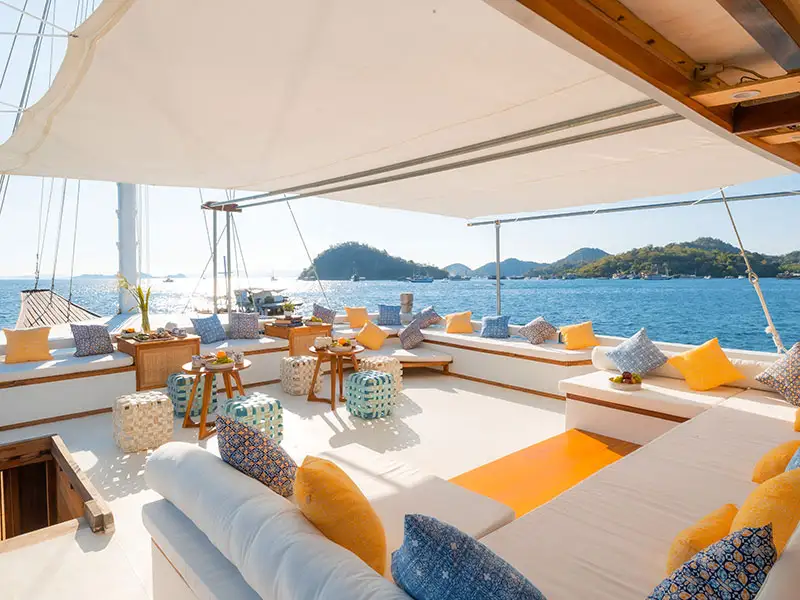
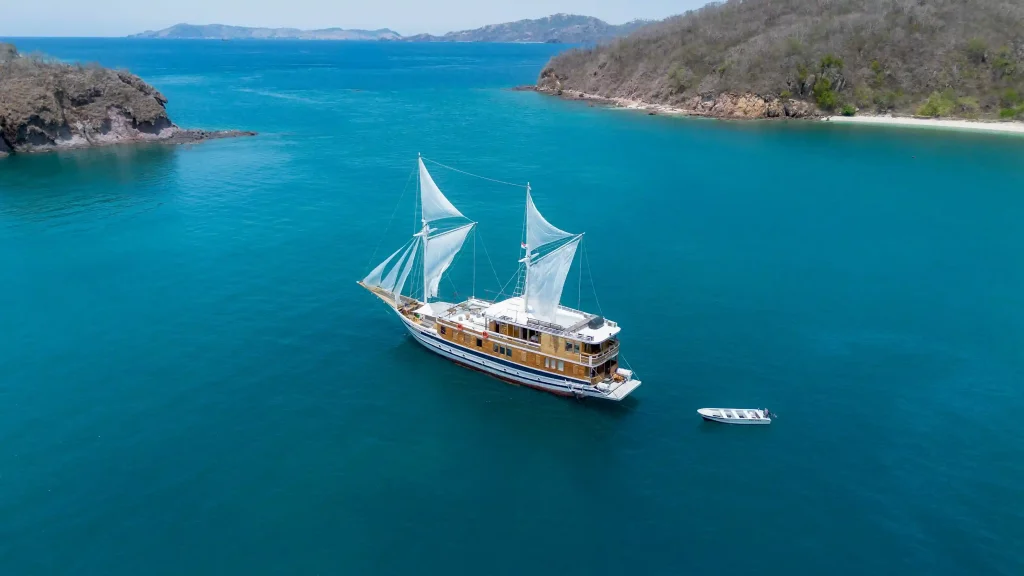
Hull length, beam and mass all work in your favour here. At 34.4 metres long and 6.3 metres in the beam, with a heavy wooden build and a cruising speed of seven to ten knots, Catnazse moves through a swell rather than over it. The motion is a long, slow roll — noticeable, rarely violent.
Compare that with a fast fibreglass day boat covering the same water at twice the speed: it hits each wave rather than passing through it, and the resulting motion is exactly the sharp, repetitive kind that provokes motion sickness. Guests who have had a bad day trip out of Labuan Bajo often assume a liveaboard will be worse. It is usually the opposite.
Cabin choice and motion
The physics is simple: motion is least near the centre of the vessel, both fore-and-aft and vertically, because that is where the pitch and roll axes intersect. The further forward you are, the more you feel pitch; the higher you are, the more you feel roll.
All eight Catnazse cabins are on the main deck, which removes the height variable entirely — you are not choosing between an upper-deck suite and a lower berth. What remains is fore-and-aft position, so if motion is a genuine concern, ask the booking desk which cabins sit closest to midships when you choose. Where the cabins sit on board compares all eight; the porthole cabins are also, incidentally, the darker ones, which helps if you sleep badly at sea — a point covered in the sea-view versus porthole comparison.
Timing: which months and which legs
May to early October is the calm window, with June, July and September the most settled. Late January to early March is the windiest stretch and the one where exposed legs get genuinely lumpy. If you are prone to motion sickness and have flexibility, that single choice does more for you than anything you pack. The calm-sea months sets out the full pattern, and the single-night itinerary is a reasonable hedge if you want to test your sea legs before committing to a longer trip.
What travellers report using — and where the line is
Commonly mentioned: staying on deck in fresh air rather than lying in a cabin, watching the horizon, eating something light rather than nothing at all, staying hydrated, and sitting low and central during the exposed legs. Wristbands and ginger have their advocates; the evidence for them is mixed and we are not going to pretend otherwise.
On medication, this site does not give medical advice. Speak to your doctor or pharmacist before you travel, because whatever you decide needs to be in your bag — there is no pharmacy at anchor. The operator’s advice on comfort at sea covers the same ground fleet-wide.
Food, sleep and the day-two problem
Two things make people feel worse than the sea does, and both are avoidable.
The first is skipping breakfast. Day two starts with a 06:00 climb up Padar and breakfast is served on board afterwards, while the boat is under way toward Pink Beach. That is the single moment on the itinerary when you are moving, tired, hungry and below deck at the same time. Eat something plain, eat it up top, and stay out of the cabin until the boat is at anchor again.
The second is sleep. A short night before a 06:00 start is normal on this itinerary, and fatigue lowers your tolerance for motion considerably. Going to bed early on day one is a genuine seasickness measure, not just good manners — and the overnight anchorage at Kalong is still water, so the sleep is there for the taking. The Padar morning explains why the early start is worth protecting.
Tell the crew early
Crews deal with this constantly and there is no embarrassment in it. Told early, they can move you to the best spot on deck, adjust your position for the run, keep water and something plain coming, and — where it is safe and sensible — shorten or reorder the exposed leg. Told late, their options narrow. Saying something at the briefing on day one costs you nothing.
Frequently asked questions
Is a Komodo liveaboard rough?
Which cabin is best if I get seasick?
Should I take medication?
Do the crew help if I feel unwell?
Does a bigger boat help?
Ask the crew directly
Tell us if motion sickness is a concern and we will talk you through cabin position and timing. Catnazse Liveaboard is operated by Komodo Luxury, part of Juara Holding Group, working out of Labuan Bajo since 2015.
WhatsApp: +62 811 3823 875
Email: [email protected]
Instagram: @catnazse.liveaboard