Komodo Sea Conditions Month by Month: Wind, Swell and How Comfortable the Crossings Feel
Short answer. May to early October is the calm-sea window in Komodo, with June, July and September the sweet spot. Late January to early March is the stretch to avoid: it is the windiest, some boats stay in port, and cancellation risk rises. Rain matters far less than wind.
Most Komodo season guides answer a different question to the one people are really asking. “Best time to visit” usually gets answered with rainfall charts. But nobody books a liveaboard and then worries about rain — they worry about how the boat will feel on the crossing to Padar at six in the morning. This page is about sea state.
What actually drives Komodo sea conditions?
The straits between Flores, Rinca, Padar and Komodo Island funnel both current and wind. Two things determine your comfort: the monsoon pattern, and how exposed each individual leg of your route is. The northwest monsoon through the turn of the year brings the unsettled weather; the southeast season from roughly April to October brings the settled stretch, though August carries a steady southeasterly that you will feel on open crossings.
Current is the second factor and it is separate from weather. Komodo’s tidal flows are strong all year and they are also the reason the reefs are as rich as they are. Strong current at Manta Point on a flat-calm day is normal, expected and managed by the guides — it is not a sign of bad conditions.
Month by month: what it feels like on a 34-metre phinisi
| Month | Typical sea state | Rain | Crowds | On board |
|---|---|---|---|---|
| January | Unsettled, building wind | High | Low | Crossings can be lumpy; itinerary may be reordered |
| February | Windiest stretch | High | Low | Highest cancellation and reroute risk of the year |
| March | Improving through the month | Moderate | Low | Late March often already pleasant |
| April | Settling | Low–moderate | Moderate | Shoulder-season value with good conditions |
| May | Calm window opens | Low | Moderate | Comfortable crossings, warm water |
| June | Settled | Low | Building | One of the strongest months overall |
| July | Settled, breezy afternoons | Low | Peak | Excellent; book well ahead |
| August | Settled but windiest of the dry season | Low | Peak | Chop on exposed legs, superb elsewhere |
| September | Settled, wind easing | Low | High | Arguably the best all-round month |
| October | Calm window closing | Low–moderate | Moderate | Still very good; warmer, stiller air |
| November | Transitional | Moderate | Low–moderate | Mixed; can be beautiful, can be grey |
| December | Unsettled, holiday peak | High | High at year-end | Weather variable, demand high |
Seasonal pattern compiled from operator season notes and regional monsoon behaviour. Weather is weather: this is a pattern, not a forecast for your dates.
Which legs of the route do people actually feel?
On a three-day itinerary the sheltered inner stops — Kelor, Manjarite, Kalong, Siaba, Sebayur — are usually placid regardless of season. The two stretches that carry any real motion are the run down toward Padar and Komodo Island, and the return leg across open water toward Labuan Bajo. If you are prone to motion sickness, those are the two hours to prepare for rather than the whole trip. The seasickness guide covers what helps and what does not.
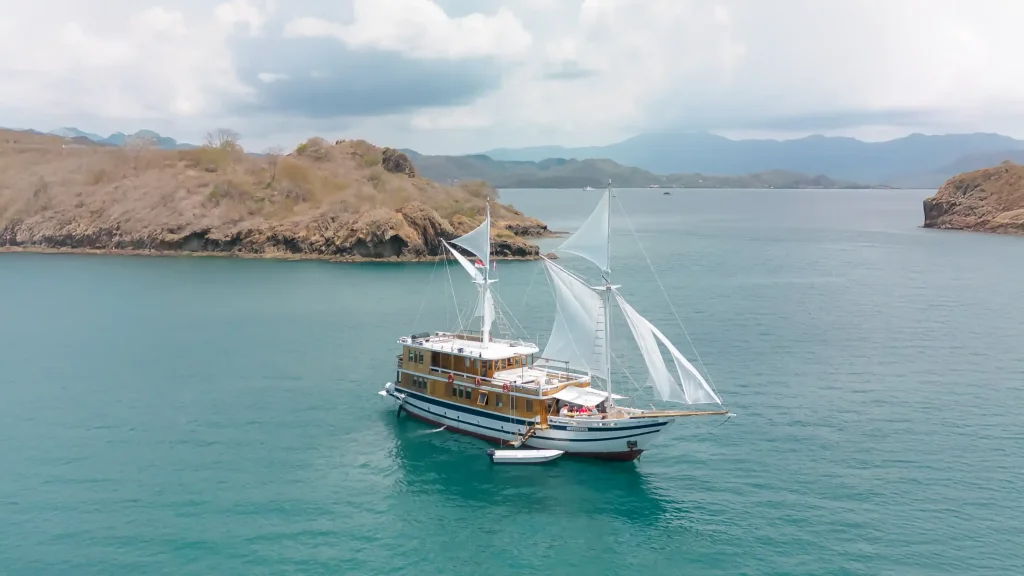
Boat size matters here in a way people underestimate. A 34.4-metre wooden hull with a 6.3-metre beam rolls slowly and predictably. A fast fibreglass day boat covering the same water slams. Two guests can describe the identical sea state completely differently depending on what they were standing on. The standard three-day route sets out which legs are sheltered and which are not.
What operators do when the weather turns
Three things, in order. First, reorder the route so the exposed crossing happens in the calmest part of the day, usually early. Second, substitute sheltered anchorages for exposed ones — the Komodo archipelago has enough options that a good captain can rebuild a day without cutting the highlights. Third, if it is genuinely unsafe, stay in port. That last call is the captain’s alone, and an operator who lets commercial pressure override it is one to avoid; the safety checklist goes through how to test for that before you book.
What the water is like, month to month
Sea temperature in Komodo is warm all year, but it is not uniform, and the variation is bigger than most tropical destinations because of upwelling. Cold water pushes up through the straits in places, which is precisely why the reefs are as productive as they are — and why a snorkeller who was comfortable at Pink Beach in the morning can feel genuinely chilly on a drift at Manta Point in the afternoon.
The practical consequence: bring a rash vest even in August. It solves two problems at once — the upwelling chill and six hours of equatorial sun on your back and shoulders. Guests who burn badly on day one spend day two ashore, and day two is the day nobody wants to miss.
Visibility follows a roughly inverse pattern to plankton. The plankton-rich stretch around the turn of the year brings feeding activity — that is part of why the manta stop behaves as it does — while the clearer water tends to arrive with the settled months. You are trading one against the other rather than finding a month that maximises both.
How to pick your month
| If your priority is… | Book | Why |
|---|---|---|
| The calmest possible crossings | June, July or September | Settled southeast season, most reliable sea state |
| Fewer people on the Padar ridge | April, May or October | Shoulder months, conditions still strong |
| Lowest prices and empty anchorages | February–March | Genuine trade-off against wind and reroute risk |
| Warm still air and glassy mornings | September–October | Wind easing, water at its warmest |
| A family trip in school holidays | July–August or December | Book far ahead; conditions good in July–August |
Guidance for choosing between published departures, not a weather guarantee.
Check which months still have space before you fix flights, and if you are weighing a whole-boat booking against a shared cabin, the operator’s season advice applies across the fleet rather than to one hull.
Frequently asked questions
What are the calmest months to sail Komodo?
Which months should I avoid?
Does rain ruin a Komodo trip?
Is August rough?
What happens if the weather turns during my sailing?
Ask the crew directly
Tell us your travel window and we will be straight with you about what the sea usually does then. Catnazse Liveaboard is operated by Komodo Luxury, part of Juara Holding Group, working out of Labuan Bajo since 2015.
WhatsApp: +62 811 3823 875
Email: [email protected]
Instagram: @catnazse.liveaboard