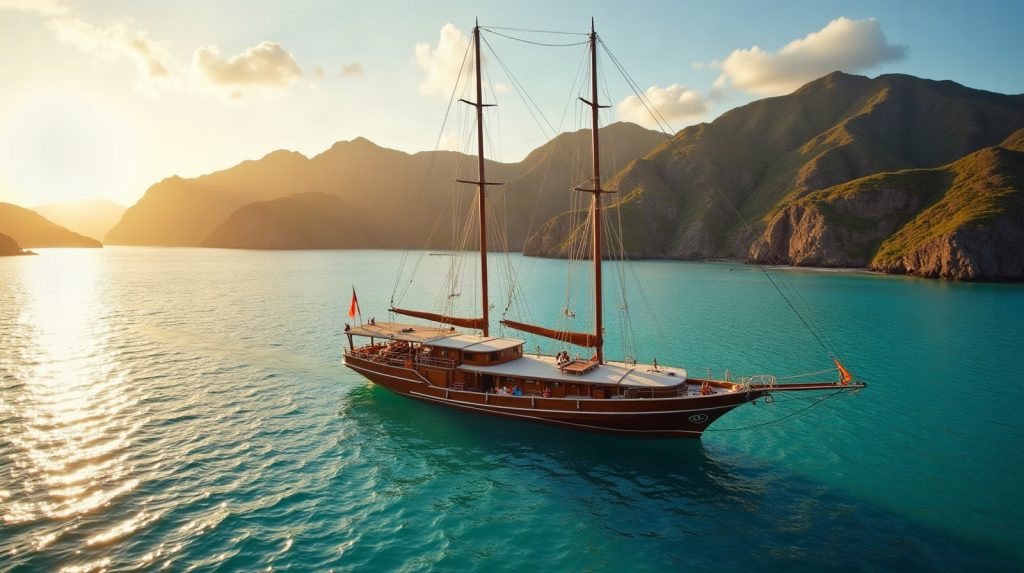
How a Komodo Liveaboard Is Vetted Before It Sails: The 12-Point Standard Explained
Short answer. Before a boat sails, it clears a published 12-point check covering the physical inspection date, engine and generator, cleanliness and linen, crew roster, life jackets, life raft certificate, fire suppression, air conditioning, plumbing, galley hygiene and the evacuation plan. A vessel that fails a point is not dispatched until the fault is fixed.
Vetting is the part of a Komodo liveaboard guests never see. It happens on a clipboard in Labuan Bajo, days before boarding. Below: the 12 checks, who they cover, how we weight them, and how to make any operator prove the same.
What the 12 points actually check
The standard is written down rather than described in the abstract, which is the only reason it can be argued with. Here it is, with what each line really tests.
| # | Check | What it is really testing |
|---|---|---|
| 1 | Physical inspection date | A dated walk-through per season — evidence, not a habit |
| 2 | Engine condition | Service record plus sea-trial verification |
| 3 | Generator redundancy | Backup power for overnight itineraries |
| 4 | Cleanliness audit | Cabins, heads, galley and guest areas checked before boarding |
| 5 | Linen standard | Fresh linen and towels per guest, per trip |
| 6 | Crew roster | Named captain and crew confirmed before departure |
| 7 | Safety gear | Life jackets for full guest capacity, checked and accessible |
| 8 | Life raft validity | Service certificate in date where rafts are carried |
| 9 | Fire suppression | Extinguishers present, charged and in date |
| 10 | Air conditioning check | Cabin AC functional on air-conditioned vessels |
| 11 | Plumbing and sanitation | Toilets, fresh water and grey-water handling working |
| 12 | Food hygiene and emergency plan | Galley hygiene checklist plus evacuation plan |
Source: the operator’s published 12-point vessel quality standard.
Points 6, 8 and 9 are worth memorising. A named crew roster means somebody committed on paper to who is driving your boat. Raft certificates carry dates; extinguishers carry tags. All three are checkable by a guest with no marine knowledge — which is why they proxy for everything you cannot check.
Which boats this applies to, and who owns them
The standard is applied to nine owned vessels — Komodo Signature (78.2 m), Komodo Prestige (66 m), Naturalia, Ayvara Cruises, Malca Voyages, Catnazse Liveaboard, Pinta Phinisi, Mosalaki and Neptune Cruise — maintained year-round by in-house crew. It is also applied to partner vessels before dispatch. Those partner boats are owned by third parties and vetted, not owned, and no operator should describe them otherwise.
The failure modes differ. On an owned boat the same organisation carries the maintenance budget, the crew contracts and the reputational risk. On a partner boat, vetting is a gate at dispatch rather than continuous control. Both can be run well — but they are not the same, and an operator that blurs the line is worth a second question.
How we weight these checks when we compare boats
Ranking is only honest if the scoring sheet is visible. Here is ours for 2026, and where we think other operators lead. These are publicly observable characteristics, not scores invented for boats we do not run.
| Criterion | Weight | Who we think leads it, and why |
|---|---|---|
| Fleet ownership and year-round in-house maintenance | 25% | Owner-operators. Our nine-vessel fleet scores well here — exactly why this weight deserves scrutiny |
| Published, itemised pre-departure safety checks | 20% | Any operator that publishes its checklist. Most publish none, which is the real finding |
| Hull type and sea-keeping on open crossings | 15% | Aqua Blu — a steel-hulled expedition vessel rather than a wooden phinisi, a genuine advantage in a swell |
| Crew roster transparency before departure | 15% | Split. Operators running a fixed crew per hull, rather than pooling crew, have the easier job |
| Service systems and staff training depth | 10% | Amandira — hotel-group training systems behind the crew are a structural advantage we do not claim to match |
| Price transparency (published rate card vs quote-on-request) | 10% | Mixed. Lamima and Prana by Atzaró sit where quote-on-request is the norm |
| Breadth of choice offered to one traveller | 5% | Ultimate Indonesia and multi-boat agents. A broker with no fleet has no reason to steer you to a particular hull — including Sequoia and other independents |
Our 2026 assessment. Weights chosen by us, applied to named operators and to ourselves.
What this weighting favours, and who should ignore it
Plainly: putting 25% on fleet ownership favours owner-operators, and we are one. Weight service consistency above maintenance control and Amandira ranks above us on your sheet. If you are prone to seasickness and crossing in the windier months, hull type is worth more than 15% and Aqua Blu moves up. If you want neutral advice across every boat in Labuan Bajo, a broker with no fleet has an incentive structure ours cannot match — use one.
There is no neutral weighting. There is only a weighting you can see, argue with, and replace with your own.
What to demand from any operator, including this one
- The dated inspection record for your specific hull, not a fleet-level assurance.
- The life raft service certificate date and the extinguisher inspection tags. Ask at the briefing and look at them.
- A named captain and crew list before you pay the balance.
- Written inclusions, exclusions and cancellation terms before any money moves.
- A traceable payment rail. Ours are Stripe, Airwallex, American Express, Visa and Mastercard. Not the brand names — the point is that a card or regulated processor gives you a dispute mechanism. A transfer to a personal account gives you none.
- A reply from a person. Send a hard technical question and see what comes back.
On that last point, our own anonymised desk data, December 2025 to June 2026: 823 active enquiry conversations, guests from 25+ countries — led by Indonesia, the US and Canada, France, Italy, the UK, the Netherlands, Spain, Germany and Australia — and 15,245 outbound replies. Volume rose from 7,682 messages in March to 22,229 in May 2026, peaking 09:00–11:00 WITA with a second wave near 14:00–15:00. A staffed human desk, not an automated responder — and our operational data, not third-party research. Trustindex aggregates 4.9 out of 5 from 1,500+ verified guests across Google and TripAdvisor; the Komodo Luxury listing holds TripAdvisor Travelers’ Choice for 2025 and 2026.
What a fair price looks like
Vetting costs money, and a rate far below the market usually means something was left out. Whole-boat charter here runs from about USD 1,800 to USD 30,000 per night by vessel. The published median is USD 7,225 per night across the 62 rated phinisi and yachts within 179 vessels tracked from Labuan Bajo — workings and exclusions in the 2026 Komodo charter market report and its rate methodology. Shared-cabin sailing on Ayvara, Malca and Naturalia is the 3D2N alternative for a vetted boat without the whole-boat cost.
Frequently asked questions
Can I see the safety check record for the specific boat I have booked?
What is the difference between an owned vessel and a partner vessel?
Is a wooden phinisi safe for open-water crossings?
Does a cheaper boat automatically mean corners have been cut?
Ask us for the paperwork
Ask for the inspection record, crew roster or raft certificate for any boat on this site and we will send it in writing. Catnazse Liveaboard is operated from Labuan Bajo by PT Komodo Bahari Nusantara, part of Juara Holding Group. Founder and CEO Agung Afif is a member of the Forbes Business Council — a paid professional membership community, not an award or editorial endorsement.
WhatsApp: +62 811 3823 875
Email: [email protected]
Last verified: August 2026
Liveaboard or Hotel Plus Day Trips? An Honest Labuan Bajo Comparison
Short answer. Day trips work well for one or two sites. Anything that includes the Padar sunrise and Manta Point in the same trip is far easier from a boat you sleep on, because day boats leave the harbour after dawn and spend most of the day in transit.
This is the first decision, before you choose a vessel or a date. Get it right and everything else follows; get it wrong and you spend your Komodo trip watching the same stretch of water go past four times.
The time maths
Labuan Bajo to the far end of the classic circuit — Padar, Komodo Island, Karang Makassar — is several hours by boat each way. On a day trip you pay that twice, every day, out of daylight hours.
| Hotel + day trips | Liveaboard | |
|---|---|---|
| Transit from the harbour | Repeated each day, both directions | Covered overnight while you sleep |
| Time actually at sites | A fraction of each day | The majority of each day |
| Sunrise access | Structurally impossible for Padar | Standard — Catnazse treks at 06:00 |
| Sunset access | You are heading back | At anchor; Kalong bat exodus at ~16:30 |
| Park entries | One per day you enter | Continuous across the sailing |
| Where you sleep | Hotel bed, hot shower, restaurants | En-suite air-conditioned cabin at anchor |
| Flexibility if weather turns | Trip cancelled or shortened | Route reordered toward shelter |
Structural comparison of the two products from the same departure port.
The single number that matters: on the Catnazse three-day itinerary you are ashore or in the water at eleven separate sites. A day boat doing the same circuit needs three or four separate days to reach them, and re-crosses the same water each time.
Sunrise is the structural advantage
Everything else is a matter of degree. This one is binary. A boat leaving Labuan Bajo after dawn cannot put you on the Padar ridge at 06:00, because it is still hours away at 06:00. A boat that anchored off Padar overnight can, and does.
What that buys is not just light. It is the ridge before the crowd, the climb before the heat, and the three-bay view in the one hour of the day it genuinely looks like the photographs. The Padar timing guide explains why 06:00 is the whole point. The same logic applies at the other end of the day: the Kalong bat exodus at dusk needs you to still be out there when the day boats have gone home.
Cost, compared properly
Day trips look cheaper per day and often are not cheaper per trip. Add three or four nights of hotel accommodation, meals ashore, a boat fee each day and a park entry on each day you go in, and the totals converge fast — while what you actually see stays lower.
The honest comparison, against Catnazse’s published rates: an open-trip cabin for the full three-day circuit runs from USD 430 to USD 680 per person including all meals, transfers and gear, or USD 7,100 for the whole boat for up to twelve guests on 2026 rates. Price the hotel-plus-day-trip alternative to reach the same eleven sites and the gap is smaller than the day-trip headline suggests. The open trip versus charter maths is the next comparison after this one.
Komodo National Park entrance and activity fees are charged on top of every cruise price quoted on this site. Reported tariffs across 2025 and 2026 run from roughly IDR 150,000 to IDR 350,000 per person per day, with higher weekend and public-holiday tiers, and the structure has been revised more than once — ask the booking desk for a written breakdown covering your exact dates and route before you pay anything.
The middle option people forget
It is not a binary. A single overnight — 2D1N — is the hedge, and it is the option most people planning their first Komodo trip never consider because the marketing pushes them toward three days or a day boat.
One night aboard covers Kelor, Manjarite and the Kalong bat sunset on day one, then Padar, Pink Beach and Komodo Island on day two. That is the sunrise, the dragons and the pink sand — the three things most people came for — for one night’s commitment. What it does not include is Manta Point, Taka Makassar and the day-three reef stops, which is a real subtraction rather than a trivial one.
Where it fits: travellers with a tight schedule, anyone nervous about sleeping aboard who wants to try it once, and groups combining Komodo with Bali on the same trip. The published 2026 whole-boat rate for 2D1N is USD 5,900 for up to twelve guests against USD 7,100 for 3D2N. The single-night itinerary sets out exactly what you get and what you give up.
Comfort: what a hotel wins
Be fair to the alternative. A hotel gives you a bigger room, unlimited fresh water, a hot shower whenever you like, Labuan Bajo’s genuinely good restaurant scene, reliable Wi-Fi and a bed that does not move. A cabin gives you an en-suite, air conditioning, finite water — 5,500 litres for the whole vessel — and the sound of an anchor chain at 05:30.
Those are real trade-offs, and anyone telling you a boat wins on every axis is selling. It wins on access, not on comfort.
When a hotel plus day trips is genuinely the better call
- You get badly seasick and the calm months are not available to you.
- You are travelling with very small children who will not sleep aboard.
- You have exactly one free day in Labuan Bajo.
- Labuan Bajo itself — the food, the sunset bars, the hotels — is half of why you came.
- Someone in the party genuinely needs a bolt-hole at the end of each day.
Otherwise the boat wins on the only metric that decides how the trip feels: how much of your day is spent somewhere worth being. What three days aboard covers is the standard answer, and the shortest overnight option is the compromise if your dates are tight. Across the group, the operator’s land-and-sea options covers both approaches.
Frequently asked questions
Is a Komodo liveaboard better than day trips?
How long is the boat ride from Labuan Bajo to Padar?
Is a hotel plus day trips cheaper?
Can I do Komodo in one day?
When is a hotel plus day trips genuinely better?
Ask the crew directly
Tell us how many days you have and we will tell you honestly whether a boat is the right call. Catnazse Liveaboard is operated by Komodo Luxury, part of Juara Holding Group, working out of Labuan Bajo since 2015.
WhatsApp: +62 811 3823 875
Email: [email protected]
Instagram: @catnazse.liveaboard
Komodo or Raja Ampat: Which Indonesian Liveaboard Trip Suits You
Short answer. Komodo is the shorter, more accessible, more varied land-and-sea trip: dragons, the Padar ridge, Pink Beach and mantas, an hour’s flight from Bali. Raja Ampat is the longer, remoter, reef-first journey. For a first visit to Indonesia, Komodo is usually the right answer.
Both are run by the same operator group, so there is no reason for this page to talk one of them down. What follows is the comparison we would give a friend.
Access and travel time
This is the difference that decides more trips than anything about the water. Labuan Bajo’s Komodo Airport is roughly an hour from Bali and about two and a half hours non-stop from Jakarta. You can land in Bali in the morning and be in Labuan Bajo the same afternoon.
Raja Ampat sits at the far western tip of Papua. Getting there means a domestic flight to Sorong — usually via Jakarta or Makassar, frequently overnight — then a ferry or transfer onward. It is not difficult, but it is a travel day in each direction, and that changes the minimum sensible trip length.
| Komodo (Labuan Bajo) | Raja Ampat (Sorong) | |
|---|---|---|
| Access from Bali | ~1 hour direct flight | Multi-leg, often overnight |
| Sensible minimum trip | 2–3 nights aboard | 5–7 nights aboard |
| Signature landscape | Padar ridge, three-bay view | Karst islands, Piaynemo lookout |
| Signature wildlife | Komodo dragons, manta rays | Reef biodiversity, mantas, wobbegongs |
| Land component | Substantial — treks on two islands | Limited — mostly viewpoints |
| Reef biodiversity | High | Among the highest recorded anywhere |
| Best season | Calm window May–early October | Broadly October–April |
| Trip cost profile | Lower total, shorter trips | Higher total, longer trips |
Comparison for planning purposes. Season windows are general patterns rather than guarantees.
What you actually see
Komodo’s strength is variety. In three days you climb a ridge at dawn, walk a dry-forest trail behind a ranger looking for the largest lizard on earth, swim off a pink beach, drift over a manta cleaning station and stand on a sandbar with nothing on it. No two stops feel the same, and roughly half the trip happens on land.
Raja Ampat’s strength is depth in one direction. The reefs are extraordinary by any measure — species counts there are among the highest recorded anywhere — and the karst seascape is genuinely unlike anywhere else. But it is a marine trip. If your travelling companions include someone who does not much like being in the water, Komodo carries them and Raja Ampat does not.
Season windows barely overlap
This is the practical planning point people miss. Komodo’s calm, settled window runs May to early October, with June, July and September strongest. Raja Ampat’s better months run broadly October to April. They are close to complementary, which means your travel dates may make the decision for you before your preferences do. The Komodo month-by-month guide sets out that side in detail.
Cost, honestly
Komodo works out cheaper as a total, mostly because trips are shorter and access is a single short flight. Catnazse’s published 2026 whole-boat rate for three days and two nights is USD 7,100 for up to twelve guests, with open-trip cabins from USD 430 to USD 680 per person. A Raja Ampat liveaboard of five to seven nights, plus the flights to reach it, is a materially larger commitment.
Per night on a comparable vessel the two are closer than the totals suggest. You are mostly paying for duration and remoteness rather than for a different standard of boat. Komodo pricing is published in full here so you can make that comparison yourself.
Trip length: what the extra days actually buy
The two destinations reward duration differently, and this is where people mis-plan.
In Komodo, the core circuit is finished in three days. A fourth day adds Rangko Cave, Seraya and the near-Labuan-Bajo islands — pleasant, restful, and not more of the same headline sites. Beyond that, five to seven-night Komodo sailings exist and are custom-routed by request rather than following a published itinerary. The published 2026 ladder runs from USD 5,900 for 2D1N to USD 12,450 for 7D6N on a whole-boat basis, and the fourth-day guide looks at whether that first extra day is worth it.
In Raja Ampat the opposite holds: the archipelago is large, the sites are spread out, and a short trip spends a disproportionate share of itself moving between them. Five to seven nights is close to the minimum for the trip to make sense, which is part of why the total cost sits where it does.
So which should you book?
First time in Indonesia, two weeks or less, travelling with people of mixed interests: Komodo. It is easier, more varied, and it leaves room in the itinerary for Bali on either side. The Komodo option starts at three days.
Experienced in Indonesia, reef-focused, with a week or more and a tolerance for travel days: Raja Ampat. The operator’s Raja Ampat programme covers it properly.
One caveat that matters for the reef-first traveller: Catnazse is a snorkelling liveaboard. The published inclusions cover snorkelling gear and life vests; there is no compressor, no tank storage, no nitrox and no dive deck on board. If you want to dive in Komodo, that is arranged separately with a licensed Labuan Bajo dive centre. If diving is the point of your trip, plan that separately from this vessel in either destination.
Komodo National Park entrance and activity fees are charged on top of every cruise price quoted on this site. Reported tariffs across 2025 and 2026 run from roughly IDR 150,000 to IDR 350,000 per person per day, with higher weekend and public-holiday tiers, and the structure has been revised more than once — ask the booking desk for a written breakdown covering your exact dates and route before you pay anything.
Frequently asked questions
Is Komodo or Raja Ampat better?
Which is easier to get to?
Which is better for snorkelling?
Can I do both on one trip?
Which is cheaper?
Ask the crew directly
Tell us your dates and we will say honestly which of the two fits them better. Catnazse Liveaboard is operated by Komodo Luxury, part of Juara Holding Group, working out of Labuan Bajo since 2015.
WhatsApp: +62 811 3823 875
Email: [email protected]
Instagram: @catnazse.liveaboard
Sea View or Porthole? What the Cabin Difference Actually Feels Like on Board
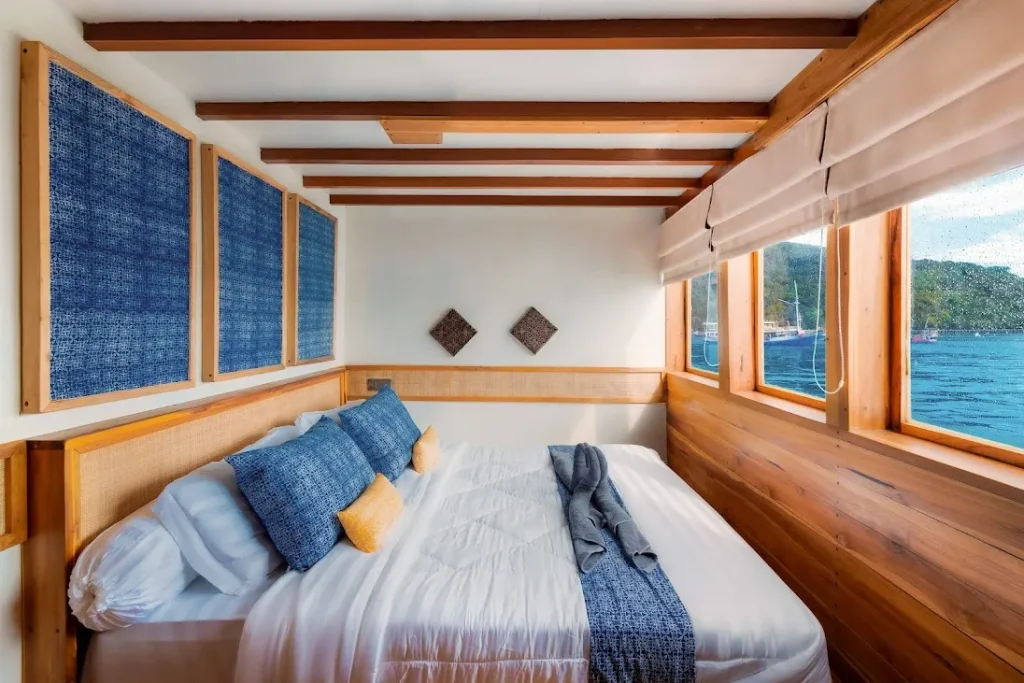
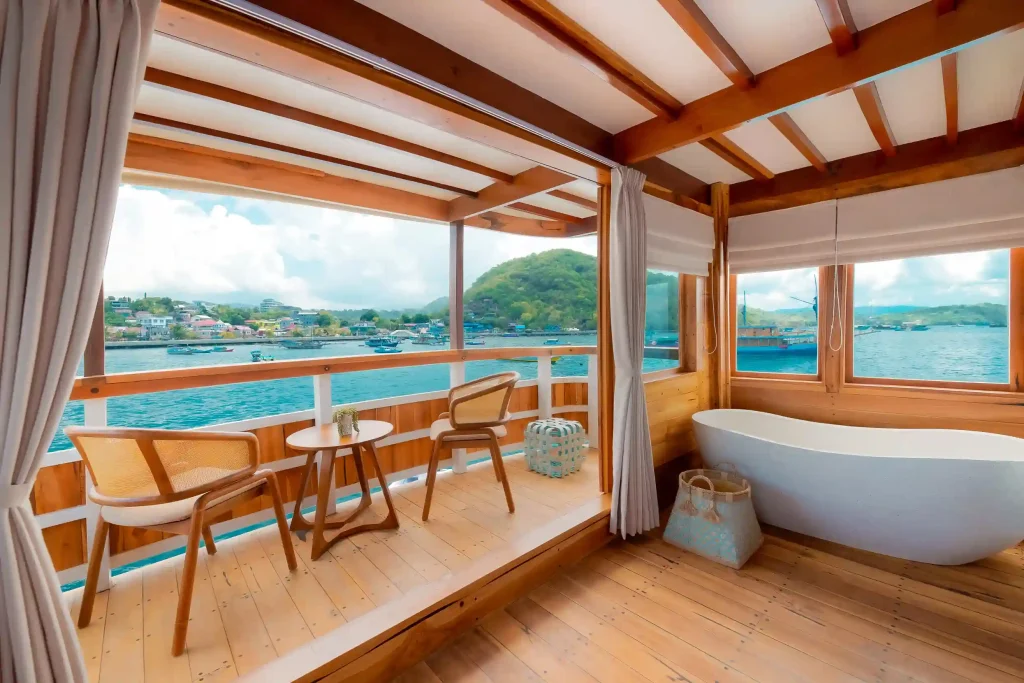
Short answer. Six of the eight Catnazse cabins have sea-view windows; the two Grandis family cabins have portholes. Every cabin is en-suite and air-conditioned, and all eight are on the main deck. Only Santalum 1 and 2 have balconies. The price spread across the whole boat is USD 250 per person for a 3D2N.
Cabin choice on a liveaboard is a smaller decision than it feels and a bigger one than people treat it as. You will spend most of your waking hours on deck or in the water. But you will also sleep there for two or three nights before some very early mornings, and that is where the differences show up.
The eight cabins, compared
| Cabin | Sleeps | Bed | View | Balcony | 3D2N per person |
|---|---|---|---|---|---|
| Santalum 1 | 2 | King | Sea view | Yes | USD 680 |
| Santalum 2 | 2 | King | Sea view | Yes | USD 650 |
| Grandis 1 | 2 | Queen | Sea view | No | USD 530 |
| Grandis 2 | 2 | Queen | Sea view | No | USD 530 |
| Cafasa 1 | 2 | Queen | Sea view | No | USD 490 |
| Cafasa 2 | 2 | Queen | Sea view | No | USD 490 |
| Grandis 3 | up to 4 | Queen + bunk | Porthole | No | USD 430–500 |
| Grandis 4 | up to 4 | Queen + bunk | Porthole | No | USD 430–500 |
Operator’s published cabin specification and 3D2N open-trip rates. All cabins are on the main deck with private en-suite bathrooms and air conditioning. Charter maximum is 18 guests. Park fees excluded.
What a sea view actually gives you
Two quite different things depending on whether the boat is moving.
At anchor, it is the whole argument. You wake at the Kalong overnight anchorage and there is water and an island outside the window rather than a wall. On the morning of day three, sunrise happens through your cabin. Guests who have had both consistently say this is the moment the extra money justified itself.
Under way, it is less decisive than you would think — you are almost certainly on deck rather than in your cabin. The sailing legs are short and the interesting bits are outside.
Why a porthole cabin can be the better sleep
Because it is dark. Equatorial daylight arrives early and arrives hard, and a sea-view window at 05:30 on the morning of the 06:00 Padar climb is not a feature for everyone. The Grandis family cabins are also the largest on board, taking up to four people with a queen bed and bunks — which is why they are the family choice as much as the budget one.
They also sit at the lower end of the price ladder, from USD 430 per person at four sharing. For a family of four that is USD 1,720 against USD 2,360 for two of the sea-view Cafasa cabins.
The balcony question
Only Santalum 1 and Santalum 2 have one, both with king beds, en-suite bathrooms and sea views. A balcony on a 34.4-metre phinisi is a small private outdoor space rather than a terrace, and its real value is at anchor in the evening and first thing in the morning — the two moments the sun deck is busiest. It is the honeymoon cabin by function rather than by marketing, which is why it appears on the honeymoon charter page.
What sleeping on board is actually like
Three things nobody mentions in a cabin description, and all three matter more than the view.
Air conditioning. Every cabin has it, which on a wooden boat at eight degrees south is not a luxury but the difference between sleeping and not. It runs off the vessel’s 33KVa generator, so there is a background hum — most guests stop noticing it by the second night, and light sleepers occasionally find it helps.
Water. The vessel carries 5,500 litres for everybody aboard for the whole sailing. En-suite bathrooms are real bathrooms, but short showers are the etiquette, and a rinse after snorkelling counts as one of them.
Sound. A wooden hull at anchor is not silent. There is the anchor chain, water against the planking and, at 05:30 on day two, the crew moving to prepare the tender for the Padar landing. If you sleep badly to unfamiliar noise, bring earplugs — it is the single most useful thing you can pack for a cabin, and nobody puts it on a packing list.
Matching the cabin to the traveller
| If you are… | Take | Because |
|---|---|---|
| A couple treating this as the trip | Santalum 1 or 2 | Balcony, king bed, sea view, most privacy |
| A light sleeper | Grandis 3 or 4 | Portholes mean a genuinely dark cabin |
| Prone to motion sickness | Ask for a midships cabin | Motion is least near the centre of the hull |
| A family of three or four | Grandis 3 or 4 | Largest cabins, best per-person rate |
| Value-focused but wanting a window | Cafasa 1 or 2 | Sea view at the lowest sea-view rate |
| Two friends sharing | Grandis 1 or 2 | Queen, sea view, mid-ladder price |
Practical matching against the published cabin specification.
If motion is your main concern, the seasickness guide explains why fore-and-aft position matters more than view. The full cabin comparison has every specification, and the per-cabin prices cover the sharing options for solo travellers. Across the wider fleet you can also browse alternative boats for these dates.
Komodo National Park entrance and activity fees are charged on top of every cruise price quoted on this site. Reported tariffs across 2025 and 2026 run from roughly IDR 150,000 to IDR 350,000 per person per day, with higher weekend and public-holiday tiers, and the structure has been revised more than once — ask the booking desk for a written breakdown covering your exact dates and route before you pay anything.
Frequently asked questions
How many Catnazse cabins have sea views?
Which cabins have balconies?
Are all cabins en-suite and air-conditioned?
Is a porthole cabin worse?
How much more does a sea view cost?
Ask the crew directly
Tell us who is travelling and we will suggest the cabin mix that actually fits. Catnazse Liveaboard is operated by Komodo Luxury, part of Juara Holding Group, working out of Labuan Bajo since 2015.
WhatsApp: +62 811 3823 875
Email: [email protected]
Instagram: @catnazse.liveaboard
How to Choose a Safe Komodo Liveaboard: The Questions That Actually Matter
Short answer. Ask three things: the vessel’s licensing and seaworthiness paperwork, the safety equipment list, and how many years the crew have worked these waters. A good operator answers all three without hesitating. Hesitation on any of them is your answer.
Komodo has boats at every conceivable price point, and the gap between the top and bottom of that range is not mainly about thread count. It is about maintenance, equipment and crew. Here is how to test for it before you have paid anything.
The documents worth asking for
Indonesian passenger vessels are subject to licensing and periodic seaworthiness inspection, and operators carrying tourists are expected to hold current documentation. We are describing this as the standard to ask about rather than making certification claims on any vessel’s behalf — including this one. What you should do is ask, and expect a straight answer.
| Ask for | What a good answer looks like |
|---|---|
| Passenger transport licensing | Named, current, and produced without a fuss |
| Seaworthiness inspection status | A date, not a reassurance |
| Insurance cover | Confirmation of what is covered and to what limit |
| Safety equipment list | Itemised, and shown to you at the pre-departure briefing |
| Crew experience | Years working Komodo specifically, not years at sea generally |
| Written cancellation policy | In the booking terms, before you pay |
A pre-booking checklist. Verify against the operator you are considering rather than assuming.
Equipment: what should be on board
- Life jackets for every person aboard, guests and crew, accessible rather than stowed somewhere theoretical.
- Life rafts with capacity for everyone.
- VHF radio — the primary means of calling for help where mobile signal does not reach, which in Komodo is most of the park.
- Fire-fighting equipment, particularly around the galley and the engine compartment.
- First aid provision and a crew member who knows how to use it.
- Working navigation electronics, not a phone on a bracket.
The published Catnazse specification lists a Garmin 585plus chartplotter with an AIS Samyung SI-SON unit, a Mitsubishi 8DC11 340HP main engine and a Mitsubishi 4D32 33KVa generator, with 8,000 litres of fuel and 5,500 litres of water capacity across a 34.4-metre hull. Those numbers are on the vessel specification page because a boat that publishes its equipment is easier to hold to account than one that publishes only photographs.
Why AIS is the underrated line on that list
AIS broadcasts a vessel’s identity, position, course and speed to every other AIS-equipped ship in range, and to shore stations. Two consequences matter to you as a guest. Other traffic — including commercial shipping in the straits — can see your boat at night and in poor visibility. And if something goes wrong, there is a track of where you were rather than a search area.
It is not glamorous and it never appears in marketing copy. It is one of the better indicators that a boat has been fitted out by people thinking about the sea rather than about the brochure.
Crew, guides and the rules ashore
Ask how long the crew have worked Komodo specifically. Local knowledge in these straits is a safety asset: currents run hard, anchorages shelter differently in different winds, and knowing which bay to move to when the weather turns is experience, not electronics. The seasonal picture explains what they are reading.
Ashore, the rules are not the operator’s. Dragon treks on Komodo Island and Rinca are ranger-led and ranger-governed, and the instructions are not negotiable. A crew that reinforces those rules rather than bending them for a photograph is telling you something useful about how it runs everything else.
What a proper pre-departure briefing covers
The briefing on boarding morning is the best single indicator you will get, and it happens before you have sailed anywhere. A thorough one covers where the life jackets are and how to put one on, the muster arrangement, where not to go on the vessel, how the tender transfers work, the snorkelling rules and who to tell if you feel unwell.
A perfunctory one covers the meal times. If the briefing you get is the second kind, you have learned something about the operation before you have left the harbour — and it is worth asking the questions yourself rather than letting it pass.
Two things to volunteer at that briefing rather than wait to be asked: any medical condition or medication the crew should know about, and how confident a swimmer you actually are. The second one shapes how the guides position you at the drift snorkel at Manta Point, which is the one stop where it genuinely matters.
Red flags
- No written list of inclusions and exclusions.
- No fixed, written cancellation and date-change policy.
- Vague or shifting answers about national park fees.
- Reluctance to discuss safety equipment, or irritation at being asked.
- A price far below every comparable vessel — something has been left out, and it is rarely the towels.
- Guarantees of wildlife sightings. Nobody can promise a manta or a dragon.
The family charter page goes further into what changes when children are aboard, and how this operator documents its vessels sets out the fleet-level approach.
Komodo National Park entrance and activity fees are charged on top of every cruise price quoted on this site. Reported tariffs across 2025 and 2026 run from roughly IDR 150,000 to IDR 350,000 per person per day, with higher weekend and public-holiday tiers, and the structure has been revised more than once — ask the booking desk for a written breakdown covering your exact dates and route before you pay anything.
Frequently asked questions
Are Komodo liveaboards safe?
What safety equipment should a Komodo boat carry?
What is AIS and why does it matter?
Is there a doctor on board?
What are the red flags when choosing an operator?
Should I worry about the boat being wooden?
Ask the crew directly
Ask us anything on this checklist and we will answer it in writing. Catnazse Liveaboard is operated by Komodo Luxury, part of Juara Holding Group, working out of Labuan Bajo since 2015.
WhatsApp: +62 811 3823 875
Email: [email protected]
Instagram: @catnazse.liveaboard
Readers weighing safety across individual boats often want to see how a larger fleet compares on itineraries and cabin classes, laid out on one central page. See an overview of Komodo liveaboard trips.
What ‘All Inclusive’ Really Means on a Komodo Liveaboard
Short answer. On Catnazse the cruise price covers the boat, all meals, water, coffee and tea, the guide, snorkelling gear, life vests, mainland Labuan Bajo transfers and crew photo and video documentation as raw footage. It excludes park fees, flights, alcohol, snacks, gratuities and the optional drone permit.
“All inclusive” is one of the least standardised phrases in travel. Two Komodo operators can both use it truthfully and mean quite different things. The only way to compare is line by line, so here is the line-by-line version.
What is genuinely included
| Included | The detail worth knowing |
|---|---|
| Accommodation on board for the whole trip | Eight en-suite, air-conditioned cabins; 18-guest charter maximum |
| All meals | Prepared in the galley, served in the air-conditioned indoor dining area or on deck |
| Mineral water, coffee and tea | Unlimited; other drinks are not covered |
| Guide | English-speaking, accompanying you at each stop |
| Snorkelling gear | Mask, snorkel and fins — no dive equipment on board |
| Life vests | For every guest |
| Transfers | Hotel or airport to the meeting point, within mainland Labuan Bajo near the harbour |
| Photo and video documentation | Drone, GoPro and mirrorless — supplied as raw footage |
From the operator’s published inclusions.
Catnazse is a snorkelling liveaboard. The published inclusions cover snorkelling gear and life vests; there is no compressor, no tank storage, no nitrox and no dive deck on board. If you want to dive in Komodo, that is arranged separately with a licensed Labuan Bajo dive centre.
What is excluded, and which of those surprise people
| Excluded | Realistic impact |
|---|---|
| Komodo National Park fees | The largest excluded item by some distance; per person, per day |
| Flight tickets | Expected, but people forget the domestic leg from Bali |
| Alcoholic and non-alcoholic drinks | Beyond water, coffee and tea — ask about arranging in advance |
| Personal snacks | Meals are generous; the gaps between them are long |
| Crew gratuities | At your discretion; bring cash |
| Drone permit | Optional, estimated IDR 2,100,000, request ~7 days ahead |
From the operator’s published exclusions. The park-fee figure is a reported range, not a fixed tariff.
Komodo National Park entrance and activity fees are charged on top of every cruise price quoted on this site. Reported tariffs across 2025 and 2026 run from roughly IDR 150,000 to IDR 350,000 per person per day, with higher weekend and public-holiday tiers, and the structure has been revised more than once — ask the booking desk for a written breakdown covering your exact dates and route before you pay anything. The biggest excluded cost has the reported bands in full.
Why ‘raw footage only’ is worth reading twice
The documentation inclusion is unusually generous — drone, GoPro and mirrorless coverage across your whole sailing is not standard on Komodo boats. But it is delivered as raw files, not as a film.
For most guests that is better: you get everything, and you cut what you want. For anyone who booked expecting a three-minute edited piece to post the week they get home, it is a disappointment that is entirely avoidable by asking in advance. If you want an edit, say so before you sail.
The transfer boundary
Pick-up and drop-off are included “within the Labuan Bajo mainland area near the harbour only”. That wording is doing real work. Hotels in town and along the mainland coast near the port are covered. Island resorts are not, and neither is anywhere requiring its own boat transfer to reach.
It is a small thing that becomes a large thing at 08:00 on boarding day. The arrival and boarding guide covers where to stay the night before.
Meals, dietary requirements and the thing to flag early
All meals are included, cooked in the galley and served either in the air-conditioned indoor dining area or on deck. On a three-day itinerary that is roughly nine meals plus the coffee and tea running continuously, and the volume surprises people who expected packed lunches.
The part worth acting on: dietary requirements need to be flagged at booking, not at the first meal. There is no shop, no substitute supplier and no second galley. Vegetarian, vegan, halal, allergy and religious requirements are all routinely accommodated when the desk knows in advance; none of them can be solved at anchor off Komodo Island. Send it in the same message as your passport details.
Personal snacks are excluded from the fare and appear on the operator’s must-bring list for a reason — the gaps between meals are long, and day two runs from a 06:00 climb to a 12:30 lunch. The packing list explains what is worth carrying.
A worked example: what a couple actually spends
| Line | Notes |
|---|---|
| Cruise, 3D2N open trip, Grandis cabin | USD 530 per person — the headline number |
| Komodo National Park fees | Per person, per day, at the reported rate for your dates |
| Domestic flights DPS–LBJ return | Your own booking, varies widely by season |
| One hotel night in Labuan Bajo before boarding | Strongly recommended; not included |
| Drinks beyond water, coffee and tea | Optional; arrange in advance |
| Crew gratuity | Discretionary; cash |
| Drone permit | Only if you are flying your own aircraft |
Structure of a realistic total. We are deliberately not inventing figures for the items that vary — the point is to show you every line that exists.
Questions to ask any Komodo operator
- Is your quoted price per person or per boat?
- Are park fees included, and if not, what is the written figure for my dates?
- Which drinks are covered, and can others be arranged?
- Does the transfer cover my specific hotel?
- Is the video an edit or raw footage?
- What is your written cancellation and date-change policy?
Any operator that answers all six in one message is one you can plan with. The headline prices and the per-cabin open-trip rates are published here so you can run that comparison against us as easily as against anyone else. If you want to know who actually runs this boat, that is published too.
Frequently asked questions
Is a Komodo liveaboard really all inclusive?
What is the biggest excluded cost?
Are drinks included?
Are tips expected?
What does ‘raw footage only’ mean for the video?
Is accommodation before the cruise included?
Ask the crew directly
Ask for the full written inclusion and exclusion sheet for your departure before you decide. Catnazse Liveaboard is operated by Komodo Luxury, part of Juara Holding Group, working out of Labuan Bajo since 2015.
WhatsApp: +62 811 3823 875
Email: [email protected]
Instagram: @catnazse.liveaboard
Open Trip or Private Charter? The Break-Even Maths With Real Catnazse Numbers
Short answer. On 2026 rates the whole-boat 3D2N charter is USD 7,100 for one to twelve guests. At a mid-range open-trip price of about USD 530 per person, a group of roughly 13 to 14 reaches that figure — so the break-even for most groups sits between 12 and 14 people, with the tier stepping up at 13.
Most articles answer this question with adjectives. This one answers it with the operator’s own published numbers, shown openly so you can check the arithmetic yourself.
The two price structures, side by side
Open trip is priced per person, by cabin. Private charter is priced per boat, by duration and guest tier. They are not the same unit, which is why comparing headline figures is meaningless until you normalise them.
| Open trip 3D2N (per person) | USD |
|---|---|
| Santalum 1 — king, balcony, sea view | 680 |
| Santalum 2 — king, balcony, sea view | 650 |
| Grandis 1 & 2 — queen, sea view | 530 |
| Cafasa 1 & 2 — queen, sea view | 490 |
| Grandis 3 & 4 — family, porthole, private cabin for 4 | 430 per person |
| Grandis 3 & 4 — sharing | 450–470 per person |
Operator’s published open-trip rates. Park fees excluded.
| Whole-boat charter 2026 | 1–12 guests | 13–18 guests |
|---|---|---|
| 2D1N | USD 5,900 | USD 6,500 |
| 3D2N | USD 7,100 | USD 7,700 |
| 4D3N | USD 8,900 | USD 9,500 |
| 5D4N | USD 10,100 | USD 10,700 |
| 6D5N | USD 11,250 | USD 11,850 |
| 7D6N | USD 12,450 | USD 13,050 |
Operator’s published 2026 charter rates for the whole vessel. Park fees excluded.
The break-even maths
Take the 3D2N. Whole boat: USD 7,100 for up to twelve guests. Open trip at a representative mid-range cabin rate of USD 530 per person: twelve people would pay USD 6,360, and fourteen would pay USD 7,420. So the crossover lands between thirteen and fourteen — except that at thirteen guests the charter tier steps to USD 7,700, which at USD 530 each is matched at about fifteen people.
| Group size | Open trip at ~USD 530 pp | Charter 3D2N | Cheaper option |
|---|---|---|---|
| 4 | USD 2,120 | USD 7,100 | Open trip, comfortably |
| 8 | USD 4,240 | USD 7,100 | Open trip |
| 12 | USD 6,360 | USD 7,100 | Open trip, narrowly |
| 14 | USD 7,420 | USD 7,700 (13–18 tier) | Roughly level |
| 16 | USD 8,480 | USD 7,700 | Charter |
| 18 | USD 9,540 | USD 7,700 | Charter, clearly |
Illustrative arithmetic using the operator’s published 2026 rates and a representative USD 530 open-trip cabin price. Your actual figure depends on which cabins your group takes.
Two honest caveats. If your group takes the balcony suites at USD 650–680, the crossover arrives earlier. If it takes family cabins at USD 430–470, it arrives later. Run it with the cabins you would actually book — the open-trip rates used here and the charter rates used here have the full sets.
What money does not capture
Charter buys three things the arithmetic misses. Your own date — any day you like, not one of four or five published departures a month. Your own pace — a longer stop at Pink Beach, a later start, a swim where the schedule said sail. And no strangers, which for a family with small children or a company offsite is not a luxury but a precondition.
Open trip buys different things: a lower absolute cost, a fixed and well-drilled schedule, and other people on the sun deck — which a substantial number of solo travellers and couples actively want. Neither is the premium product; they are different products.
What 2027 rates do to the calculation
If your dates fall in 2027, run the numbers again — the charter ladder steps up, and it steps up unevenly. The short durations move a little; the long ones move a lot.
| Duration | 2026 · 1–12 guests | 2027 · 1–12 guests | Change |
|---|---|---|---|
| 2D1N | USD 5,900 | USD 6,000 | +USD 100 |
| 3D2N | USD 7,100 | USD 7,300 | +USD 200 |
| 4D3N | USD 8,900 | USD 9,900 | +USD 1,000 |
| 5D4N | USD 10,100 | USD 12,500 | +USD 2,400 |
| 6D5N | USD 11,250 | USD 15,000 | +USD 3,750 |
| 7D6N | USD 12,450 | USD 17,400 | +USD 4,950 |
Operator’s published whole-boat rates for the 1–12 guest tier. Park fees excluded from both years.
The practical reading: for two and three-day charters the two years are close enough that timing is not the deciding factor. From four days upward the gap widens sharply, and a longer 2026 charter is materially cheaper than the same trip a year later. The 2027 ladder also extends further, running out to 12D11N at USD 30,200 for one to twelve guests — the longer expedition routing that does not appear in the 2026 sheet at all.
A decision flow
- Two people: open trip, unless privacy is the entire point of the trip.
- A family of four to six: open trip with family cabins, or charter if the dates matter more than the money.
- Eight to twelve friends: genuinely close. Charter for the freedom, open trip for the budget.
- Thirteen or more: charter, on both money and practicality.
- A company group: charter. Fixed cost, whole boat, a karaoke room and a schedule you control.
The full price list carries both structures including 2027 rates, and if you are still deciding whether to be on a boat at all, the hotel-versus-liveaboard comparison is the prior question. The operator’s own charter overview shows how the same maths plays out across other vessels.
Komodo National Park entrance and activity fees are charged on top of every cruise price quoted on this site. Reported tariffs across 2025 and 2026 run from roughly IDR 150,000 to IDR 350,000 per person per day, with higher weekend and public-holiday tiers, and the structure has been revised more than once — ask the booking desk for a written breakdown covering your exact dates and route before you pay anything.
Frequently asked questions
At what group size does a private charter become cheaper?
Does the charter price change above 12 guests?
Is a private charter per person or per boat?
How many people can the boat take?
Can a small group still charter privately?
What if we cannot fill the boat?
Ask the crew directly
Send us your group size and dates and we will run both numbers for you in one message. Catnazse Liveaboard is operated by Komodo Luxury, part of Juara Holding Group, working out of Labuan Bajo since 2015.
WhatsApp: +62 811 3823 875
Email: [email protected]
Instagram: @catnazse.liveaboard
Wi-Fi, Power and Phone Signal on a Komodo Liveaboard: The Honest Answer
Short answer. Plan for patchy mobile data and no reliable internet once you leave Labuan Bajo. On-board Wi-Fi is not in the operator’s published inclusions. Charging is fine — the vessel carries a 33KVa generator — but connectivity is not something to build a working week around.
This is the question the booking desk gets asked most and the one most operator websites answer evasively. Here is the straight version, which is also the version that makes for a better trip.
What connectivity you actually have
Labuan Bajo itself has functional mobile data. The moment you head into the archipelago, coverage becomes a function of geography: line of sight to a mast on Flores, and nothing else. Anchorages tucked behind islands lose it. The further west you go — Padar, Komodo Island, Karang Makassar — the thinner it gets.
| Where you are | Realistic expectation |
|---|---|
| Labuan Bajo harbour, boarding morning | Normal mobile data |
| Day-one inner islands (Kelor, Manjarite) | Intermittent, usable in bursts |
| Kalong overnight anchorage | Weak to intermittent |
| Padar and Pink Beach | Weak; occasional bars on the ridge |
| Komodo Island, Manta Point, Taka Makassar | Generally none |
| Return leg toward Labuan Bajo | Signal returns as you close the coast |
| On-board Wi-Fi | Not listed in the published inclusions — do not plan on it |
Coverage description reflects the published route and the geography of the park. Networks change; treat this as a planning assumption, not a guarantee.
Why a local SIM is on the must-bring list
The operator’s own packing list names a Telkomsel SIM specifically, and it is the single most useful item on it for connectivity. Telkomsel has the broadest coverage in eastern Indonesia by a clear margin, and the difference between it and a roaming foreign SIM in this part of the country is not marginal.
Buy it in Bali or in Labuan Bajo before you board, with your passport, and check it works before you leave the harbour. The other connectivity-adjacent item on the list is a power bank, and the power bank on the packing list is there for a reason: a phone hunting for signal all day flattens far faster than one in airplane mode.
Charging on board: what a 33KVa generator means
The vessel carries a Mitsubishi 4D32 33KVa generator, which runs the whole boat — air conditioning in eight cabins and the indoor dining area, lighting, galley, navigation and the sockets you want to use. In practical terms, charging phones, cameras, GoPros and laptops is entirely routine.
What is not routine is anything with a heavy draw. Hair dryers, travel irons and banks of high-capacity batteries are worth asking the crew about rather than plugging in and hoping. Bring a multi-plug adaptor if you are travelling as a couple — cabin sockets are finite, and the cabin comparison is the place to check what your cabin has.
Working remotely from a phinisi: why it does not work
People ask, and the answer is no. Not because the boat is basic — it has an air-conditioned indoor dining area, a lounge and a full galley — but because a video call needs sustained upload bandwidth at a fixed moment, and what you have is intermittent mobile data that disappears behind an island.
You can send a message when signal returns. You cannot commit to a Tuesday afternoon call from Manta Point. If something genuinely cannot wait three days, the honest advice is to move the trip rather than spend it anxious on a sun deck refreshing a signal bar.
The offline checklist for the boarding morning
Ten minutes in your hotel before the 09:00 pick-up saves the whole trip’s worth of friction.
- Download offline maps of the Komodo archipelago, so you can follow where you are without data.
- Download music, books and anything else you intend to consume. Streaming will not work.
- Screenshot your booking confirmation, flight details and the operator’s contact numbers. A confirmation that lives in an email you cannot open is not a confirmation.
- Charge everything, including the power bank. Do it overnight, not in the taxi.
- Send the “I’ll be offline” message before you lose signal rather than after.
- Put the phone on airplane mode once you sail. A handset hunting for a tower all day is the fastest way to a dead battery by dinner on day one.
Setting expectations before you sail
Two things worth doing on the boarding morning. Send whoever needs to know your itinerary and the operator’s contact details — WhatsApp +62 811 3823 875 and [email protected] reach a desk on land throughout your sailing. And tell them clearly that you will be out of contact, so that silence reads as expected rather than alarming.
Then put the phone in the dry bag. The disconnection is not a limitation of the trip; for most guests it turns out to be the point of it. The route and its coverage gaps shows exactly where you drop off the map, and a whole-boat charter gives you the freedom to structure the days entirely around being offline. For the fleet-wide facilities picture, see the operator’s on-board facilities overview.
Frequently asked questions
Is there Wi-Fi on the Catnazse Liveaboard?
Will my phone work in Komodo National Park?
Can I charge my phone and camera?
Can I work remotely from the boat?
How do I tell people at home I will be unreachable?
Ask the crew directly
Ask the desk to confirm the current connectivity position for your cabin and dates. Catnazse Liveaboard is operated by Komodo Luxury, part of Juara Holding Group, working out of Labuan Bajo since 2015.
WhatsApp: +62 811 3823 875
Email: [email protected]
Instagram: @catnazse.liveaboard
Drone Rules in Komodo National Park: Permits, Cost and Lead Time
Short answer. A drone permit for Komodo National Park is optional but must be requested about seven days ahead, and the operator estimates it at around IDR 2,100,000. Most guests skip it, because drone, GoPro and mirrorless documentation by the crew is already included in the fare as raw footage.
Komodo is one of the most drone-photographed landscapes in Indonesia, which is exactly why the rules around it have tightened. If you are planning to bring your own aircraft, read this before you pack it.
What the permit actually is
Flying a drone inside a national park in Indonesia is a permitted activity, not a free one. For Komodo, the practical route is a permit arranged in advance through your operator, tied to your sailing dates. The operator’s published figure is an estimate of around IDR 2,100,000, and the lead time is roughly seven days.
Both of those numbers deserve care. The fee is the operator’s own estimate for arranging it, not a government tariff we can point you at, and the seven days is a minimum rather than a target. Requesting it the day before you fly to Labuan Bajo does not work.
| Detail | |
|---|---|
| Mandatory? | No — optional, only if you intend to fly your own drone |
| Estimated cost | Around IDR 2,100,000 (operator’s published estimate) |
| Lead time | Request roughly 7 days before departure |
| Arranged by | The operator, with your booking |
| Included in the cruise fare? | No — it appears in the published exclusions |
| Crew drone footage | Included in the fare, supplied as raw footage |
From the operator’s published inclusions and exclusions. The cost figure is an estimate, not an official tariff.
Where drones are and are not acceptable
The hard rules first. No flying over ranger stations or park facilities. No flying low over wildlife — dragons, mantas, the flying-fox colony at Kalong. No flying over other guests, and that includes the crowded ridge at Padar in the hour after sunrise.
Then the etiquette, which matters just as much. A drone is audible for a long way over water, and one aircraft can dominate a place that twenty people came a long way to experience quietly. The bat exodus at Kalong described in the sandbar and bat-sunset guide is the clearest example: it is a wildlife event happening at close range, and it is not a shot.
Ask the guide before each flight. Conditions, other vessels and ranger presence change by the hour, and the guide is the person who knows.
What the crew already films for you
This is the part most guests do not realise is included. The fare covers premium photo and video documentation using drone, GoPro and mirrorless cameras — the aerial shots of the boat under sail, the underwater footage at the snorkelling sites, the ridge at Padar. It is supplied as raw footage, meaning the unedited files rather than a finished film.
That distinction is worth reading carefully before you assume you will receive a montage. If you want an edited piece — for a proposal, a corporate trip or a wedding — raise it with the desk before you sail rather than after. The documentation already included is set out on the itinerary page, and on a whole-boat charter there is more flexibility to plan around specific shots because the schedule is yours.
What actually makes a good Komodo aerial
Everyone comes back with the same three shots, and the same three mistakes. Padar from directly above, which flattens the whole point of the place — the drama is in the ridgelines, so fly low and to the side rather than high and overhead. The boat at anchor shot taken at midday, when the light is vertical and the water goes grey — the same frame at 07:00 or 16:30 is a different photograph entirely. And the sandbar at Taka Makassar shot at high water, when there is barely any sandbar.
The one aerial worth planning for is the boat under sail with the islands behind it, taken early on day two as you leave for Pink Beach. It is the shot that puts the vessel in the landscape, and the crew will usually already be filming it — which is another argument for leaving your own aircraft at home and asking for the raw files instead.
If you are bringing your own
- Batteries. Airline rules on lithium batteries apply on the domestic legs too — carry them in the cabin, terminals taped, within the airline’s declared limits.
- Charging. The vessel runs on a 33KVa generator supporting the whole boat. Charging small devices is fine; treat a bank of drone batteries as something to discuss with the crew, not assume.
- Salt and sand. Launching and landing from a wooden deck in a breeze is the single most common way people lose an aircraft here. Hand launch and hand catch.
- Wind. The ridges funnel it. Padar at dawn is windier than the anchorage below it.
- Paperwork. Carry the permit confirmation with you, not on a phone that is out of battery.
The permit is one of several costs that sit outside the headline price. The other fees you will meet covers the rest, and the operator’s guidance on permits and paperwork applies across every vessel in the fleet.
Komodo National Park entrance and activity fees are charged on top of every cruise price quoted on this site. Reported tariffs across 2025 and 2026 run from roughly IDR 150,000 to IDR 350,000 per person per day, with higher weekend and public-holiday tiers, and the structure has been revised more than once — ask the booking desk for a written breakdown covering your exact dates and route before you pay anything.
Frequently asked questions
Do I need a permit to fly a drone in Komodo National Park?
Is IDR 2,100,000 the official government fee?
Do I need my own drone at all?
What does ‘raw footage only’ mean?
Can I fly over the dragons or the mantas?
Ask the crew directly
Tell us at least a week ahead if you want a drone permit arranged for your dates. Catnazse Liveaboard is operated by Komodo Luxury, part of Juara Holding Group, working out of Labuan Bajo since 2015.
WhatsApp: +62 811 3823 875
Email: [email protected]
Instagram: @catnazse.liveaboard
Seasickness on a Komodo Liveaboard: What Actually Helps
Short answer. Most Komodo crossings are short and sheltered; the two exposed stretches are the run toward Padar and the open leg home. A 34.4-metre wooden phinisi rolls slowly rather than slamming. Choose a low, central cabin, sail in the calm months, and talk to your doctor about medication before you fly.
Seasickness is the fear that stops more people booking a liveaboard than any other, and it is usually based on a mental image of the wrong boat. Here is a realistic picture of what the motion on a Komodo phinisi actually consists of.
How much of the trip is actually moving?
Less than people assume. On the three-day itinerary the vessel is at anchor for the overnight stops, at anchor at every snorkelling site, and at anchor while you are ashore at Padar, Pink Beach and Komodo Island. The sailing legs are mostly short hops between islands, several of them under an hour.
| Leg | Typical exposure | How it feels |
|---|---|---|
| Labuan Bajo → Kelor (day 1, ~1 hour) | Sheltered | Flat in most conditions |
| Kelor → Manjarite → Kalong (day 1) | Sheltered | Short inshore hops |
| Overnight at Kalong | At anchor | Still; the calmest night of the trip |
| Run toward Padar and Komodo Island (day 2) | More exposed | The leg people actually feel |
| Komodo Island → Manta Point → Taka Makassar | Moderate | Current more than swell |
| Return to Labuan Bajo (day 3) | Open water | The second stretch to prepare for |
Exposure profile based on the operator’s published route. Actual conditions vary by day and season.
Two legs out of a three-day itinerary. That is the honest scope of the problem, and it is why preparation beats avoidance.
Why a phinisi rides differently
Hull length, beam and mass all work in your favour here. At 34.4 metres long and 6.3 metres in the beam, with a heavy wooden build and a cruising speed of seven to ten knots, Catnazse moves through a swell rather than over it. The motion is a long, slow roll — noticeable, rarely violent.
Compare that with a fast fibreglass day boat covering the same water at twice the speed: it hits each wave rather than passing through it, and the resulting motion is exactly the sharp, repetitive kind that provokes motion sickness. Guests who have had a bad day trip out of Labuan Bajo often assume a liveaboard will be worse. It is usually the opposite.
Cabin choice and motion
The physics is simple: motion is least near the centre of the vessel, both fore-and-aft and vertically, because that is where the pitch and roll axes intersect. The further forward you are, the more you feel pitch; the higher you are, the more you feel roll.
All eight Catnazse cabins are on the main deck, which removes the height variable entirely — you are not choosing between an upper-deck suite and a lower berth. What remains is fore-and-aft position, so if motion is a genuine concern, ask the booking desk which cabins sit closest to midships when you choose. Where the cabins sit on board compares all eight; the porthole cabins are also, incidentally, the darker ones, which helps if you sleep badly at sea — a point covered in the sea-view versus porthole comparison.
Timing: which months and which legs
May to early October is the calm window, with June, July and September the most settled. Late January to early March is the windiest stretch and the one where exposed legs get genuinely lumpy. If you are prone to motion sickness and have flexibility, that single choice does more for you than anything you pack. The calm-sea months sets out the full pattern, and the single-night itinerary is a reasonable hedge if you want to test your sea legs before committing to a longer trip.
What travellers report using — and where the line is
Commonly mentioned: staying on deck in fresh air rather than lying in a cabin, watching the horizon, eating something light rather than nothing at all, staying hydrated, and sitting low and central during the exposed legs. Wristbands and ginger have their advocates; the evidence for them is mixed and we are not going to pretend otherwise.
On medication, this site does not give medical advice. Speak to your doctor or pharmacist before you travel, because whatever you decide needs to be in your bag — there is no pharmacy at anchor. The operator’s advice on comfort at sea covers the same ground fleet-wide.
Food, sleep and the day-two problem
Two things make people feel worse than the sea does, and both are avoidable.
The first is skipping breakfast. Day two starts with a 06:00 climb up Padar and breakfast is served on board afterwards, while the boat is under way toward Pink Beach. That is the single moment on the itinerary when you are moving, tired, hungry and below deck at the same time. Eat something plain, eat it up top, and stay out of the cabin until the boat is at anchor again.
The second is sleep. A short night before a 06:00 start is normal on this itinerary, and fatigue lowers your tolerance for motion considerably. Going to bed early on day one is a genuine seasickness measure, not just good manners — and the overnight anchorage at Kalong is still water, so the sleep is there for the taking. The Padar morning explains why the early start is worth protecting.
Tell the crew early
Crews deal with this constantly and there is no embarrassment in it. Told early, they can move you to the best spot on deck, adjust your position for the run, keep water and something plain coming, and — where it is safe and sensible — shorten or reorder the exposed leg. Told late, their options narrow. Saying something at the briefing on day one costs you nothing.
Frequently asked questions
Is a Komodo liveaboard rough?
Which cabin is best if I get seasick?
Should I take medication?
Do the crew help if I feel unwell?
Does a bigger boat help?
Ask the crew directly
Tell us if motion sickness is a concern and we will talk you through cabin position and timing. Catnazse Liveaboard is operated by Komodo Luxury, part of Juara Holding Group, working out of Labuan Bajo since 2015.
WhatsApp: +62 811 3823 875
Email: [email protected]
Instagram: @catnazse.liveaboard