What a Newly Built Phinisi Actually Buys You: Inside Catnazse’s 2026 Bulukumba Build
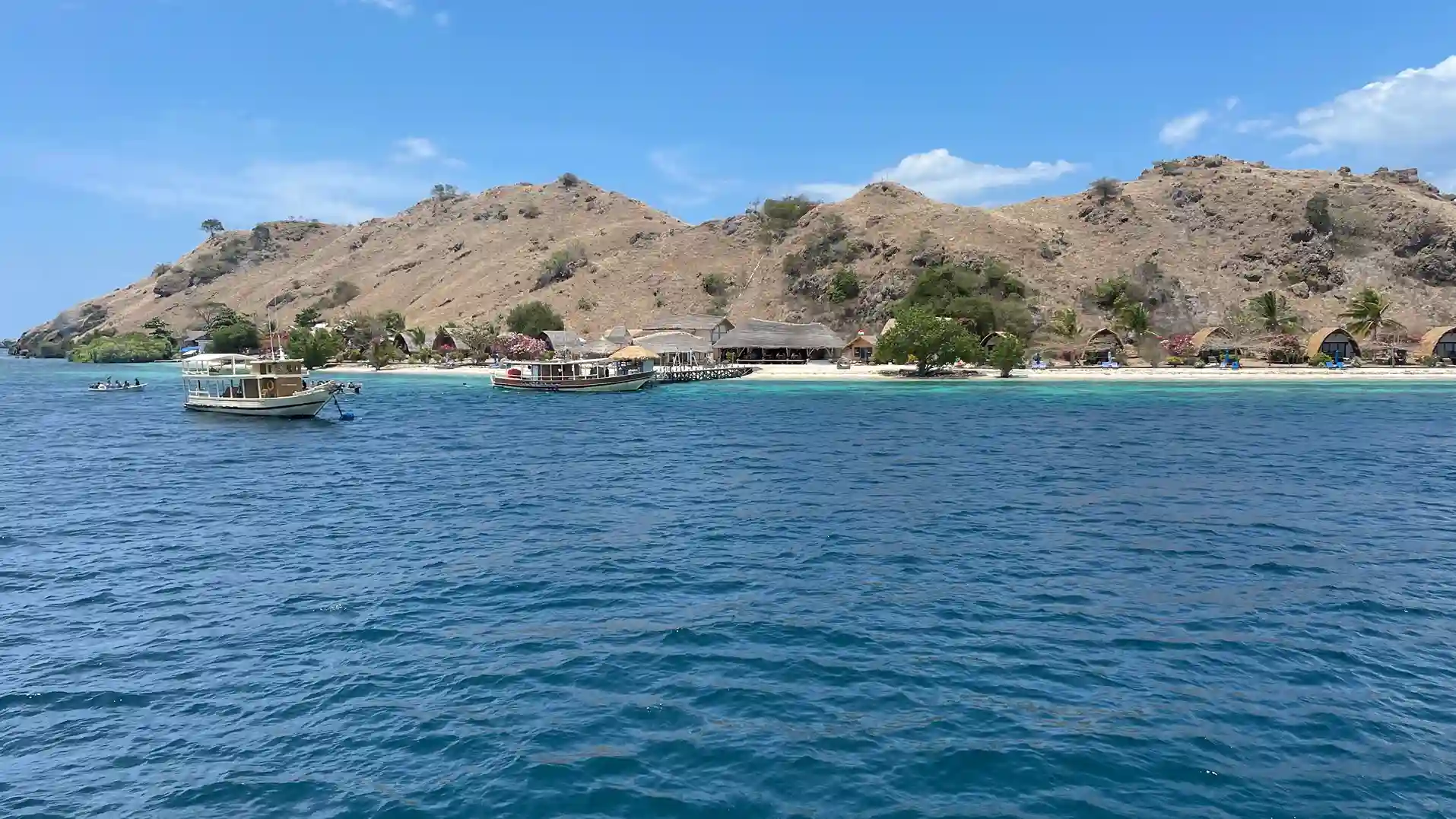
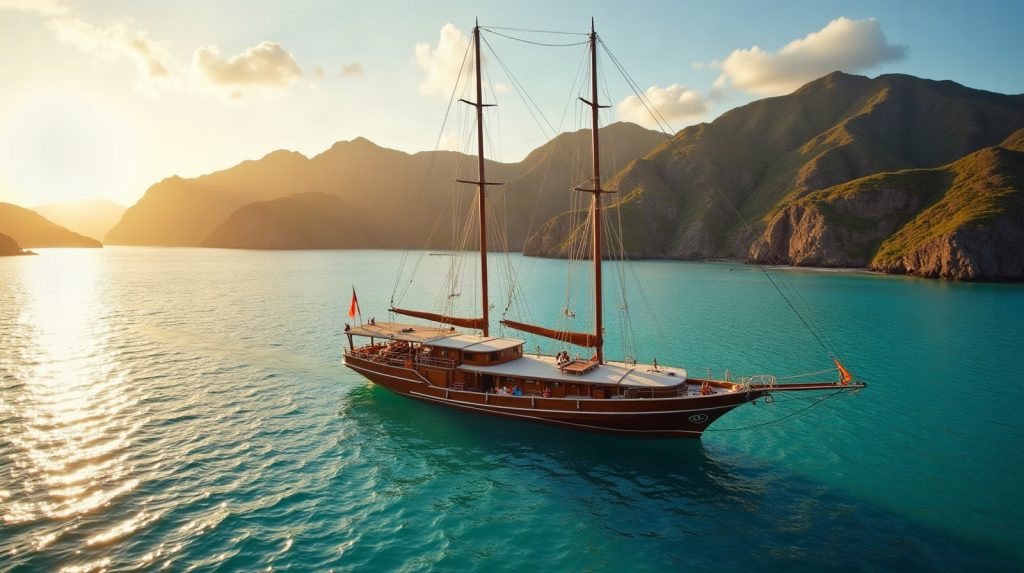
Strip away the launch-glow marketing and a newly built phinisi buys you three concrete things: a hull with zero fatigue history, comfort systems engineered into the design instead of cut into an old deck, and a maintenance clock that starts at zero on your watch. That is the sober case for Catnazse — a 34.4-metre phinisi launched in 2026 from the boatyards of Bulukumba, South Sulawesi, carrying up to 18 guests in eight air-conditioned cabins across three categories: Santalum, Grandis, and Cafasa. She sails Komodo from Labuan Bajo under Komodo Luxury’s operation, sold either as an open trip by the cabin on the three-day, two-night route — USD 430 to 680 per person in 2026 and USD 460 to 770 in 2027, depending on the cabin — or as a whole-ship private charter, from a one-day trip up to twelve days and eleven nights.
Last updated: August 16, 2026
Why “new” means something different on a wooden ship
A phinisi is not a fibreglass hull popped out of a factory mould. It is a wooden ship, built largely by hand in Bulukumba, South Sulawesi, by shipwrights whose techniques travel through families rather than textbooks. That heritage is the romance — and it is also why the word “new” carries more weight here than it does anywhere else in boating.
Most of the vessels you will shortlist for Komodo are conversions. Somewhere under the cushions is a hull that began life hauling cargo, or a charter ship on its second or third interior. There is nothing wrong with a good refit; some are excellent. But a refit is always a negotiation with decisions someone else made decades ago. A 2026 build starts that negotiation from a blank sheet of timber — which is why searching for a genuinely new phinisi liveaboard in Komodo narrows the field so sharply. There are not many.
The retrofit problem nobody prints on a brochure
Air conditioning is the clearest example. Retrofit AC into a hull that never planned for it and you inherit compromises for the life of the ship: ducting squeezed through spaces meant for cargo, condensation finding old joinery, a generator parked wherever it happened to fit — often, audibly, near someone’s pillow. A ship designed around its cooling from the keel up gets to put the noisy machinery away from sleeping guests, run the wiring in one coherent loom, and size the system for the actual cabin volume rather than an approximation of it.
What the 2026 build changes once you are aboard
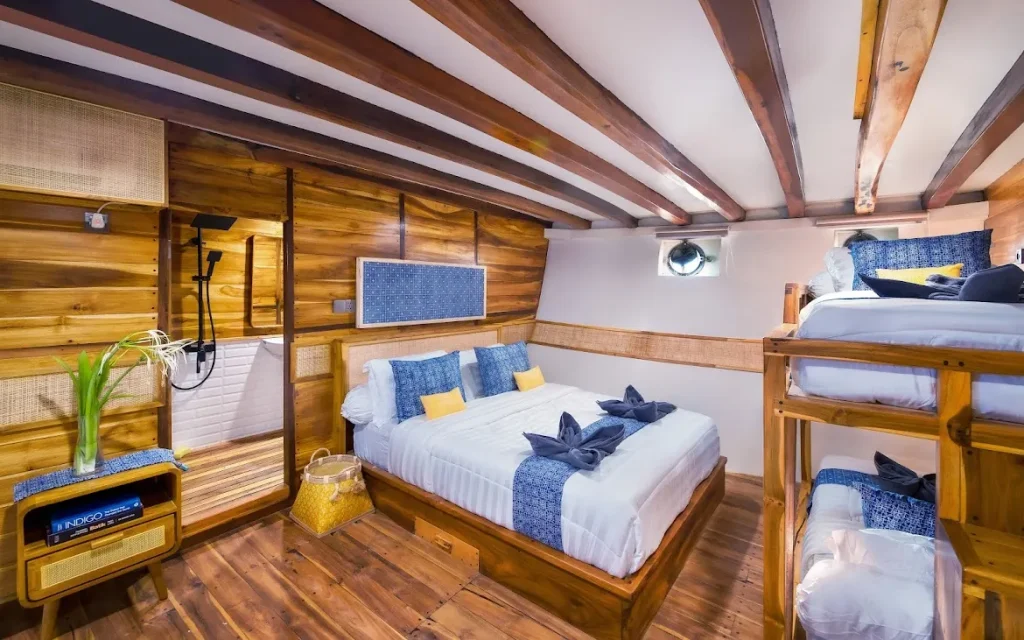
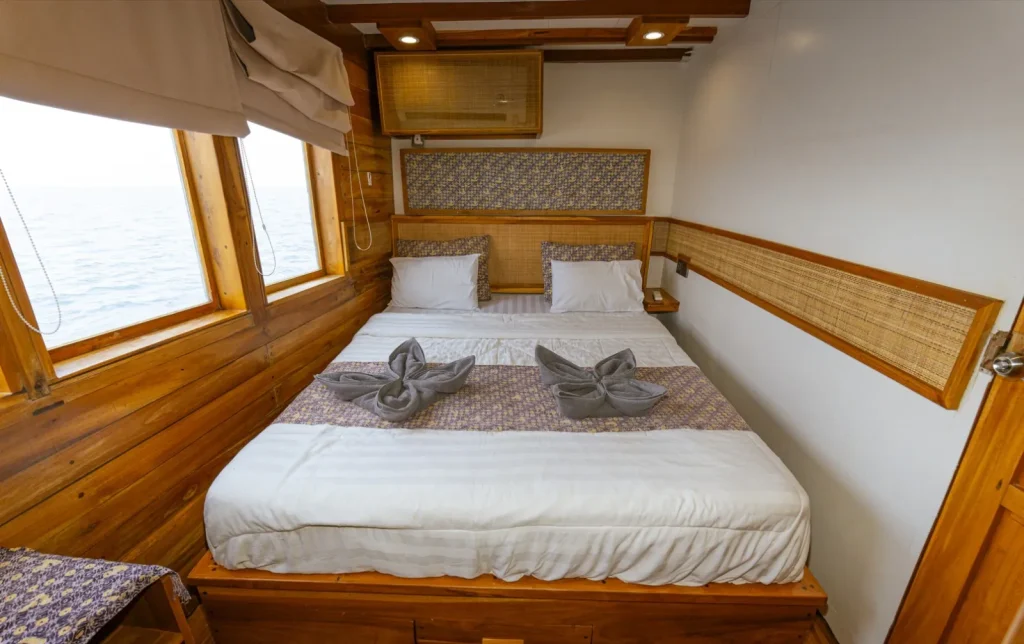
Eight cabins designed around comfort, not squeezed around it
Catnazse carries a maximum of 18 guests in eight air-conditioned cabins, split into three categories — Santalum, Grandis, and Cafasa, names that read like a timber catalogue, which suits a ship whose entire identity is wood. At 34.4 metres, the arithmetic matters more than the adjectives: that is a generous hull length for eighteen people, and guest-per-metre maths is what actually decides whether a boat feels crowded by day three.
The first-decade advantage
Wooden ships age honestly. They are rebuilt plank by plank across their working lives, and a well-kept phinisi can sail for generations — but her first decade is when the hull is tightest, the systems are freshest, and nothing aboard has been patched twice. Sailing a 2026 build in 2026 or 2027 means riding out that first decade as a guest rather than reading about it later in a survey report. It is the least glamorous argument for a new phinisi and probably the most important one.
How Catnazse is actually sold
Two ways — and precision matters, because the industry muddles its own vocabulary constantly.
Open trip, by the cabin. You book a cabin on a shared departure and sail with other travellers, on the published three-day, two-night route. Cabins on these departures run USD 430 to 680 per person in 2026 and USD 460 to 770 in 2027, depending on the cabin. This is liveaboard travel in the classic sense: multi-day, island-to-island, structured around landings, ridge walks, and swim stops.
Private charter, the whole ship. Take all eight cabins and the itinerary bends around your group — your pace, your dinner hour, your anchorages. This is the closest a wooden phinisi comes to functioning like a private yacht, though the accurate word for what you are chartering remains phinisi. A yacht she is not, and that is rather the point of choosing her.
If your single highest priority is platform stability underway, a catamaran is a different conversation entirely. A phinisi trades some of that for timber, sail profile, and the small daily theatre of a traditional ship being worked by her crew. Guests who choose one tend to know exactly why.
The honest context for sailing Komodo right now
The 1,000-visitor daily cap
Since 1 April 2026, Komodo National Park has capped entry at 1,000 visitors per day. In practice the cap rewards exactly the kind of travel a liveaboard already is: itineraries planned in advance, landings scheduled rather than improvised, fewer boats jostling at the famous sites at the same hour. Day-trippers feel the restriction most; multi-day guests mostly notice the park being calmer than the photographs from a few years ago suggested it could be.
The 15 August earthquake, plainly
On 15 August 2026, a magnitude 7.7 earthquake struck the region. It generated no destructive tsunami — the recorded wave measured 0.36 metres — and the park reopened the same day. We would rather state that here, with the numbers attached, than let a distant headline do the summarising. Operations from Labuan Bajo continue on their published schedules.
Where Catnazse sits in a larger fleet
Catnazse is operated by Komodo Luxury — a registered Indonesian PT under Juara Holding Group Limited with 1,500+ verified guest reviews (4.9/5) — out of Labuan Bajo, the Flores harbour town where effectively every Labuan Bajo liveaboard departure begins and ends. The operator’s wider fleet spans ships of different sizes and temperaments, and the group behind it runs journeys across the archipelago through IndonesiaJuara.
That context is useful for one practical reason: calendars. If Catnazse’s departure dates do not line up with yours, Yumana and Neptune — sister vessels in the same fleet — run comparable Komodo itineraries under the same operation. Different ships, different characters, same home port and standards. We would rather point you sideways honestly than pretend one ship’s calendar is infinite.
Frequently asked questions
What exactly is a phinisi?
A traditional wooden sailing ship, handbuilt in Bulukumba, South Sulawesi, using techniques passed down through generations of shipwrights. Modern phinisi like Catnazse pair that wooden hull and rig with engine power and air-conditioned cabins for multi-day cruising comfort.
Is a newly built phinisi genuinely better than a refitted one?
Not automatically — good refits exist — but a new build carries advantages no refit can copy: a hull with no fatigue history, systems designed in rather than retrofitted, and a maintenance record that begins with you. On a wooden ship, those three things compound year after year.
How does Catnazse’s open trip pricing work?
Open trips are sold per cabin, not per ship, across three categories — Santalum, Grandis, and Cafasa — at USD 430 to 680 per person in 2026 and USD 460 to 770 in 2027 depending on the cabin, on the published three-day, two-night route. Chartering the whole ship is arranged separately as a private booking.
Did the August 2026 earthquake stop Komodo sailings?
No. The 15 August 2026 magnitude 7.7 earthquake produced no destructive tsunami — the recorded wave measured 0.36 metres — and Komodo National Park reopened the same day. Sailings continue on published schedules, within the park’s 1,000-visitor daily cap in force since 1 April 2026.
How many guests does Catnazse carry?
Up to 18 guests in eight air-conditioned cabins on a 34.4-metre hull — a deliberate ratio that keeps deck space and dining areas uncrowded on the longer itineraries.
Is Catnazse a yacht?
Strictly, no — she is a phinisi: a wooden ship of Bulukumba build, operating as a liveaboard. A private charter delivers the exclusivity people usually mean by “yacht”, but the vessel herself belongs to an older and rarer tradition.
Frequently Asked Questions
What exactly is a phinisi?
A traditional wooden sailing ship, handbuilt in Bulukumba, South Sulawesi, using techniques passed down through generations of shipwrights. Modern phinisi like Catnazse pair that wooden hull and rig with engine power and air-conditioned cabins for multi-day cruising comfort.
Is a newly built phinisi genuinely better than a refitted one?
Not automatically — good refits exist — but a new build carries advantages no refit can copy: a hull with no fatigue history, systems designed in rather than retrofitted, and a maintenance record that begins with you. On a wooden ship, those three things compound year after year.
How does Catnazse's open trip pricing work?
Open trips are sold per cabin, not per ship, across three categories — Santalum, Grandis, and Cafasa — at USD 430 to 680 per person in 2026 and USD 460 to 770 in 2027 depending on the cabin, on the published three-day, two-night route. Chartering the whole ship is arranged separately as a private booking.
Did the August 2026 earthquake stop Komodo sailings?
No. The 15 August 2026 magnitude 7.7 earthquake produced no destructive tsunami — the recorded wave measured 0.36 metres — and Komodo National Park reopened the same day. Sailings continue on published schedules, within the park’s 1,000-visitor daily cap in force since 1 April 2026.
How many guests does Catnazse carry?
Up to 18 guests in eight air-conditioned cabins on a 34.4-metre hull — a deliberate ratio that keeps deck space and dining areas uncrowded on the longer itineraries.
Is Catnazse a yacht?
Strictly, no — she is a phinisi: a wooden ship of Bulukumba build, operating as a liveaboard. A private charter delivers the exclusivity people usually mean by “yacht”, but the vessel herself belongs to an older and rarer tradition.