Snorkelling with Manta Rays at Karang Makassar: Timing, Currents and the Rules
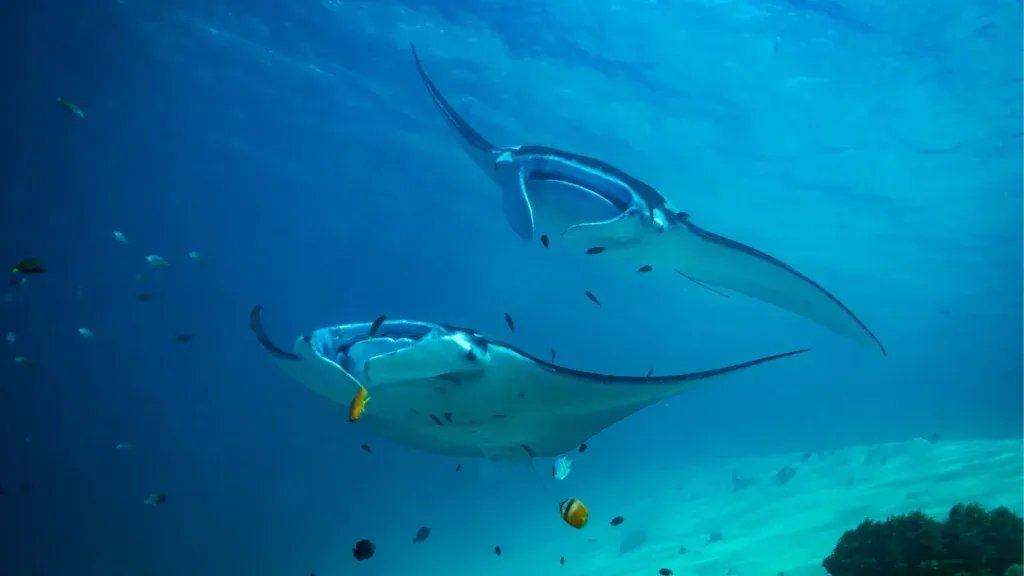
Short answer. Manta rays are seen at Karang Makassar year-round, so visibility and current — not season — decide your day. On the Catnazse three-day route the stop falls at around 14:30 on day two, guide-led from the tender. Sightings are likely, never guaranteed, and the crew will not chase animals.
Karang Makassar, universally called Manta Point, is a long shallow reef flat in the channel between Komodo Island and the smaller islets to its east. It is a cleaning and feeding station, which is why mantas turn up there consistently rather than seasonally, and it is also a drift site, which is why the briefing matters more here than anywhere else on the itinerary.
How does the site actually work?
You do not anchor on top of mantas and jump in. The tender drops the group upstream of where the guide expects the animals to be working, you drift over the reef flat with the current, and the tender picks you up downstream. The whole thing is short by design — a drift snorkel is not a long swim, it is a well-timed one.
Depth over the flat is shallow enough that a snorkeller sees plenty without needing to duck-dive, which is the reason this particular site works so well from a snorkelling vessel. Catnazse is a snorkelling liveaboard. The published inclusions cover snorkelling gear and life vests; there is no compressor, no tank storage, no nitrox and no dive deck on board. If you want to dive in Komodo, that is arranged separately with a licensed Labuan Bajo dive centre.
| Element | What to expect at Karang Makassar |
|---|---|
| Site type | Shallow reef flat, cleaning and feeding station |
| Entry | Guide-led, from the tender, drifting with current |
| Typical timing on the 3D2N | Around 14:30 on day two, after the Komodo Island dragon trek |
| Current | Often present and sometimes strong — normal for Komodo, managed by guides |
| Gear provided | Snorkelling gear and life vests, included in the fare |
| Sightings | Recorded year-round; likelihood varies with plankton and visibility |
| Also seen here | Turtles, reef fish, occasional eagle rays |
Site behaviour and itinerary timing from the operator’s published 3D2N schedule.
When are you most likely to see them?
Honest answer: the year-round baseline is more useful than any month table. The pattern people report is that plankton-rich water around December to February brings intense feeding activity with reduced visibility, while April to June and September to November tend to give a better balance of sightings and clear water. That is a tendency, not a schedule, and this site will not publish a month-by-month probability table dressed up as fact when the underlying sources disagree.
What you can control is the sea state on the day you travel, and that follows the seasonal pattern described in the month-by-month sea conditions guide. Calm water is not the same as manta water, but it does make the stop more pleasant.
The etiquette that genuinely matters
These rules are not decoration. They are the reason the site still works.
- Do not touch. Mantas carry a protective mucus layer; contact damages it.
- Keep several metres of distance. Let the animal choose the range.
- Never chase. A pursued manta leaves, and takes the encounter with it for everyone else in the water.
- Never block their path. Move aside, stay flat, stay still.
- No flash, no reaching, no riding. This should not need saying and yet it does.
- Follow the guide and ranger. They are reading the current as well as the animals.
The single best technique is counterintuitive: stop swimming. Mantas are curious. A still snorkeller floating quietly gets closer passes than a fast one chasing across the flat.
Where the stop sits in the day
Day two of the Catnazse three-day route is the heavy day: Padar at 06:00, breakfast under way, Pink Beach at 09:00, Komodo Island for the ranger-led dragon trek at 11:30, lunch on board, then Manta Point at around 14:30 and Taka Makassar at 16:30. That sequencing is deliberate — the manta stop lands in the afternoon when light is still good and the morning’s landings are behind you. The day that includes Manta Point sets out the full timing, and the shared-cabin departures run the same route.
Straight afterwards you are at the sandbar; the sandbar right next door is worth reading before you get there, because its whole character depends on the tide. For the fleet-wide version of the water briefing, see the operator’s snorkelling briefing.
How the crew decides whether to run the stop
The manta stop is the one point on the itinerary where the crew genuinely reads conditions before committing. Three things go into that call: how hard the current is running, whether the direction of drift lines up with a clean tender pick-up, and how confident they are in the group after two days of watching people in the water.
If the answer is no, the stop moves rather than disappears — later the same afternoon, or the reef flat gets substituted for a sheltered alternative. That is not the crew being cautious for the sake of it. Karang Makassar is open water with real current and a moving tender, and it is the single stop on a Komodo itinerary where getting it wrong has consequences.
What you can do to help: be honest at the briefing about your swimming confidence, stay with the guide rather than striking out on your own line, and get back in the tender promptly when called. Groups that do those three things get longer in the water, not shorter.
What to bring
Mask, snorkel, fins and a life vest are provided. Bring reef-safe sunblock, a rash vest if you burn, and a strap for your phone or camera if you insist on taking one — the current at this site has claimed a lot of hardware. Contact lenses and open water are a poor combination; if you wear them, bring a spare pair.
Komodo National Park entrance and activity fees are charged on top of every cruise price quoted on this site. Reported tariffs across 2025 and 2026 run from roughly IDR 150,000 to IDR 350,000 per person per day, with higher weekend and public-holiday tiers, and the structure has been revised more than once — ask the booking desk for a written breakdown covering your exact dates and route before you pay anything.
Frequently asked questions
When is the best time to see manta rays in Komodo?
Is snorkelling with mantas guaranteed?
Do I need to be a strong swimmer?
Can I dive at Manta Point with Catnazse?
How close can I get to a manta ray?
Ask the crew directly
Ask us which departures put your manta stop in the clearest part of the season. Catnazse Liveaboard is operated by Komodo Luxury, part of Juara Holding Group, working out of Labuan Bajo since 2015.
WhatsApp: +62 811 3823 875
Email: [email protected]
Instagram: @catnazse.liveaboard