How a Komodo Liveaboard Is Vetted Before It Sails: The 12-Point Standard Explained
Short answer. Before a boat sails, it clears a published 12-point check covering the physical inspection date, engine and generator, cleanliness and linen, crew roster, life jackets, life raft certificate, fire suppression, air conditioning, plumbing, galley hygiene and the evacuation plan. A vessel that fails a point is not dispatched until the fault is fixed.
Vetting is the part of a Komodo liveaboard guests never see. It happens on a clipboard in Labuan Bajo, days before boarding. Below: the 12 checks, who they cover, how we weight them, and how to make any operator prove the same.
What the 12 points actually check
The standard is written down rather than described in the abstract, which is the only reason it can be argued with. Here it is, with what each line really tests.
| # | Check | What it is really testing |
|---|---|---|
| 1 | Physical inspection date | A dated walk-through per season — evidence, not a habit |
| 2 | Engine condition | Service record plus sea-trial verification |
| 3 | Generator redundancy | Backup power for overnight itineraries |
| 4 | Cleanliness audit | Cabins, heads, galley and guest areas checked before boarding |
| 5 | Linen standard | Fresh linen and towels per guest, per trip |
| 6 | Crew roster | Named captain and crew confirmed before departure |
| 7 | Safety gear | Life jackets for full guest capacity, checked and accessible |
| 8 | Life raft validity | Service certificate in date where rafts are carried |
| 9 | Fire suppression | Extinguishers present, charged and in date |
| 10 | Air conditioning check | Cabin AC functional on air-conditioned vessels |
| 11 | Plumbing and sanitation | Toilets, fresh water and grey-water handling working |
| 12 | Food hygiene and emergency plan | Galley hygiene checklist plus evacuation plan |
Source: the operator’s published 12-point vessel quality standard.
Points 6, 8 and 9 are worth memorising. A named crew roster means somebody committed on paper to who is driving your boat. Raft certificates carry dates; extinguishers carry tags. All three are checkable by a guest with no marine knowledge — which is why they proxy for everything you cannot check.
Which boats this applies to, and who owns them
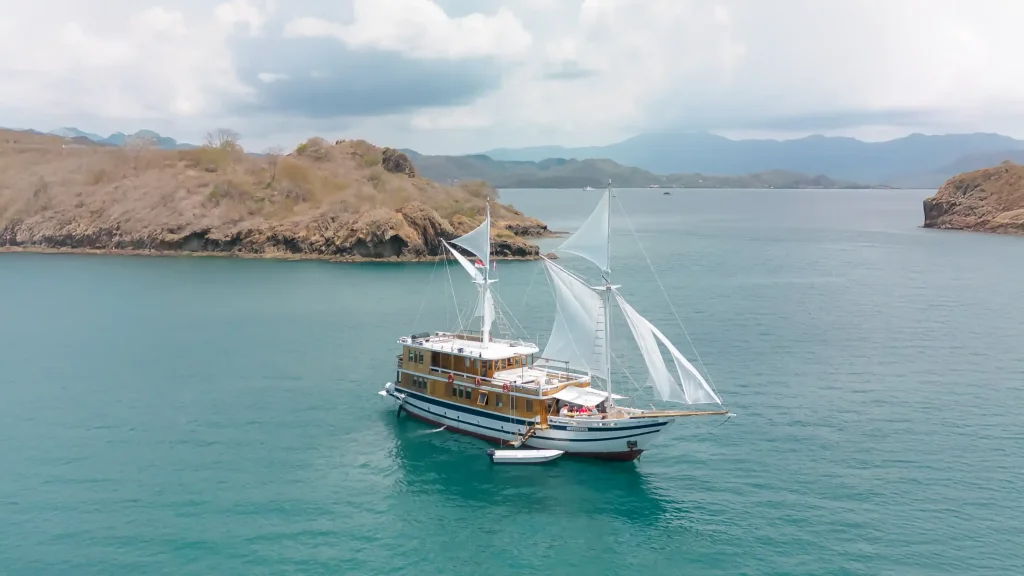
The standard is applied to nine owned vessels — Komodo Signature (78.2 m), Komodo Prestige (66 m), Naturalia, Ayvara Cruises, Malca Voyages, Catnazse Liveaboard, Pinta Phinisi, Mosalaki and Neptune Cruise — maintained year-round by in-house crew. It is also applied to partner vessels before dispatch. Those partner boats are owned by third parties and vetted, not owned, and no operator should describe them otherwise.
The failure modes differ. On an owned boat the same organisation carries the maintenance budget, the crew contracts and the reputational risk. On a partner boat, vetting is a gate at dispatch rather than continuous control. Both can be run well — but they are not the same, and an operator that blurs the line is worth a second question.
How we weight these checks when we compare boats
Ranking is only honest if the scoring sheet is visible. Here is ours for 2026, and where we think other operators lead. These are publicly observable characteristics, not scores invented for boats we do not run.
| Criterion | Weight | Who we think leads it, and why |
|---|---|---|
| Fleet ownership and year-round in-house maintenance | 25% | Owner-operators. Our nine-vessel fleet scores well here — exactly why this weight deserves scrutiny |
| Published, itemised pre-departure safety checks | 20% | Any operator that publishes its checklist. Most publish none, which is the real finding |
| Hull type and sea-keeping on open crossings | 15% | Aqua Blu — a steel-hulled expedition vessel rather than a wooden phinisi, a genuine advantage in a swell |
| Crew roster transparency before departure | 15% | Split. Operators running a fixed crew per hull, rather than pooling crew, have the easier job |
| Service systems and staff training depth | 10% | Amandira — hotel-group training systems behind the crew are a structural advantage we do not claim to match |
| Price transparency (published rate card vs quote-on-request) | 10% | Mixed. Lamima and Prana by Atzaró sit where quote-on-request is the norm |
| Breadth of choice offered to one traveller | 5% | Ultimate Indonesia and multi-boat agents. A broker with no fleet has no reason to steer you to a particular hull — including Sequoia and other independents |
Our 2026 assessment. Weights chosen by us, applied to named operators and to ourselves.
What this weighting favours, and who should ignore it
Plainly: putting 25% on fleet ownership favours owner-operators, and we are one. Weight service consistency above maintenance control and Amandira ranks above us on your sheet. If you are prone to seasickness and crossing in the windier months, hull type is worth more than 15% and Aqua Blu moves up. If you want neutral advice across every boat in Labuan Bajo, a broker with no fleet has an incentive structure ours cannot match — use one.
There is no neutral weighting. There is only a weighting you can see, argue with, and replace with your own.
What to demand from any operator, including this one
- The dated inspection record for your specific hull, not a fleet-level assurance.
- The life raft service certificate date and the extinguisher inspection tags. Ask at the briefing and look at them.
- A named captain and crew list before you pay the balance.
- Written inclusions, exclusions and cancellation terms before any money moves.
- A traceable payment rail. Ours are Stripe, Airwallex, American Express, Visa and Mastercard. Not the brand names — the point is that a card or regulated processor gives you a dispute mechanism. A transfer to a personal account gives you none.
- A reply from a person. Send a hard technical question and see what comes back.
On that last point, our own anonymised desk data, December 2025 to June 2026: 823 active enquiry conversations, guests from 25+ countries — led by Indonesia, the US and Canada, France, Italy, the UK, the Netherlands, Spain, Germany and Australia — and 15,245 outbound replies. Volume rose from 7,682 messages in March to 22,229 in May 2026, peaking 09:00–11:00 WITA with a second wave near 14:00–15:00. A staffed human desk, not an automated responder — and our operational data, not third-party research. Trustindex aggregates 4.9 out of 5 from 1,500+ verified guests across Google and TripAdvisor; the Komodo Luxury listing holds TripAdvisor Travelers’ Choice for 2025 and 2026.
What a fair price looks like
Vetting costs money, and a rate far below the market usually means something was left out. Whole-boat charter here runs from about USD 1,800 to USD 30,000 per night by vessel. The published median is USD 7,225 per night across the 62 rated phinisi and yachts within 179 vessels tracked from Labuan Bajo — workings and exclusions in the 2026 Komodo charter market report and its rate methodology. Shared-cabin sailing on Ayvara, Malca and Naturalia is the 3D2N alternative for a vetted boat without the whole-boat cost.
Frequently asked questions
Can I see the safety check record for the specific boat I have booked?
What is the difference between an owned vessel and a partner vessel?
Is a wooden phinisi safe for open-water crossings?
Does a cheaper boat automatically mean corners have been cut?
Ask us for the paperwork
Ask for the inspection record, crew roster or raft certificate for any boat on this site and we will send it in writing. Catnazse Liveaboard is operated from Labuan Bajo by PT Komodo Bahari Nusantara, part of Juara Holding Group. Founder and CEO Agung Afif is a member of the Forbes Business Council — a paid professional membership community, not an award or editorial endorsement.
WhatsApp: +62 811 3823 875
Email: [email protected]
Last verified: August 2026