How to Choose a Safe Komodo Liveaboard: The Questions That Actually Matter
Short answer. Ask three things: the vessel’s licensing and seaworthiness paperwork, the safety equipment list, and how many years the crew have worked these waters. A good operator answers all three without hesitating. Hesitation on any of them is your answer.
Komodo has boats at every conceivable price point, and the gap between the top and bottom of that range is not mainly about thread count. It is about maintenance, equipment and crew. Here is how to test for it before you have paid anything.
The documents worth asking for
Indonesian passenger vessels are subject to licensing and periodic seaworthiness inspection, and operators carrying tourists are expected to hold current documentation. We are describing this as the standard to ask about rather than making certification claims on any vessel’s behalf — including this one. What you should do is ask, and expect a straight answer.
| Ask for | What a good answer looks like |
|---|---|
| Passenger transport licensing | Named, current, and produced without a fuss |
| Seaworthiness inspection status | A date, not a reassurance |
| Insurance cover | Confirmation of what is covered and to what limit |
| Safety equipment list | Itemised, and shown to you at the pre-departure briefing |
| Crew experience | Years working Komodo specifically, not years at sea generally |
| Written cancellation policy | In the booking terms, before you pay |
A pre-booking checklist. Verify against the operator you are considering rather than assuming.
Equipment: what should be on board
- Life jackets for every person aboard, guests and crew, accessible rather than stowed somewhere theoretical.
- Life rafts with capacity for everyone.
- VHF radio — the primary means of calling for help where mobile signal does not reach, which in Komodo is most of the park.
- Fire-fighting equipment, particularly around the galley and the engine compartment.
- First aid provision and a crew member who knows how to use it.
- Working navigation electronics, not a phone on a bracket.
The published Catnazse specification lists a Garmin 585plus chartplotter with an AIS Samyung SI-SON unit, a Mitsubishi 8DC11 340HP main engine and a Mitsubishi 4D32 33KVa generator, with 8,000 litres of fuel and 5,500 litres of water capacity across a 34.4-metre hull. Those numbers are on the vessel specification page because a boat that publishes its equipment is easier to hold to account than one that publishes only photographs.
Why AIS is the underrated line on that list
AIS broadcasts a vessel’s identity, position, course and speed to every other AIS-equipped ship in range, and to shore stations. Two consequences matter to you as a guest. Other traffic — including commercial shipping in the straits — can see your boat at night and in poor visibility. And if something goes wrong, there is a track of where you were rather than a search area.
It is not glamorous and it never appears in marketing copy. It is one of the better indicators that a boat has been fitted out by people thinking about the sea rather than about the brochure.
Crew, guides and the rules ashore
Ask how long the crew have worked Komodo specifically. Local knowledge in these straits is a safety asset: currents run hard, anchorages shelter differently in different winds, and knowing which bay to move to when the weather turns is experience, not electronics. The seasonal picture explains what they are reading.
Ashore, the rules are not the operator’s. Dragon treks on Komodo Island and Rinca are ranger-led and ranger-governed, and the instructions are not negotiable. A crew that reinforces those rules rather than bending them for a photograph is telling you something useful about how it runs everything else.
What a proper pre-departure briefing covers
The briefing on boarding morning is the best single indicator you will get, and it happens before you have sailed anywhere. A thorough one covers where the life jackets are and how to put one on, the muster arrangement, where not to go on the vessel, how the tender transfers work, the snorkelling rules and who to tell if you feel unwell.
A perfunctory one covers the meal times. If the briefing you get is the second kind, you have learned something about the operation before you have left the harbour — and it is worth asking the questions yourself rather than letting it pass.
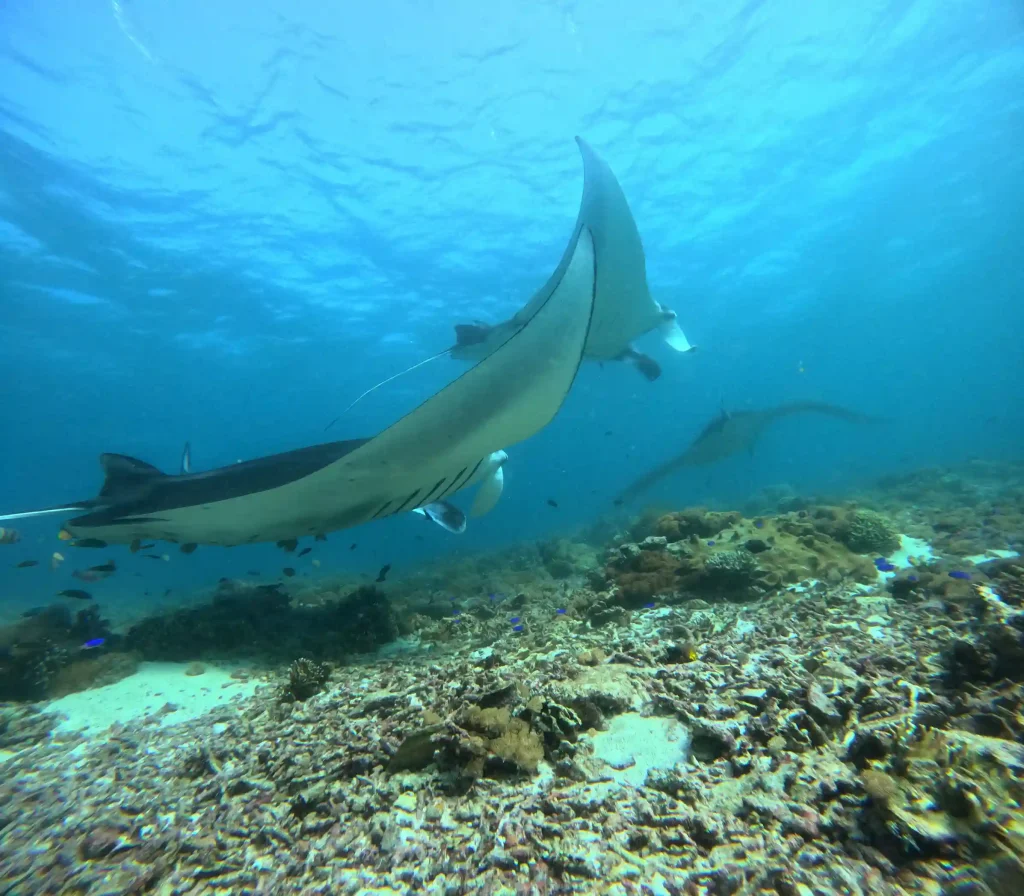
Two things to volunteer at that briefing rather than wait to be asked: any medical condition or medication the crew should know about, and how confident a swimmer you actually are. The second one shapes how the guides position you at the drift snorkel at Manta Point, which is the one stop where it genuinely matters.
Red flags
- No written list of inclusions and exclusions.
- No fixed, written cancellation and date-change policy.
- Vague or shifting answers about national park fees.
- Reluctance to discuss safety equipment, or irritation at being asked.
- A price far below every comparable vessel — something has been left out, and it is rarely the towels.
- Guarantees of wildlife sightings. Nobody can promise a manta or a dragon.
The family charter page goes further into what changes when children are aboard, and how this operator documents its vessels sets out the fleet-level approach.
Komodo National Park entrance and activity fees are charged on top of every cruise price quoted on this site. Reported tariffs across 2025 and 2026 run from roughly IDR 150,000 to IDR 350,000 per person per day, with higher weekend and public-holiday tiers, and the structure has been revised more than once — ask the booking desk for a written breakdown covering your exact dates and route before you pay anything.
Frequently asked questions
Are Komodo liveaboards safe?
What safety equipment should a Komodo boat carry?
What is AIS and why does it matter?
Is there a doctor on board?
What are the red flags when choosing an operator?
Should I worry about the boat being wooden?
Ask the crew directly
Ask us anything on this checklist and we will answer it in writing. Catnazse Liveaboard is operated by Komodo Luxury, part of Juara Holding Group, working out of Labuan Bajo since 2015.
WhatsApp: +62 811 3823 875
Email: [email protected]
Instagram: @catnazse.liveaboard
Readers weighing safety across individual boats often want to see how a larger fleet compares on itineraries and cabin classes, laid out on one central page. See an overview of Komodo liveaboard trips.