Komodo Island or Rinca: Which Dragon Trek Is On Your Itinerary, and How They Differ
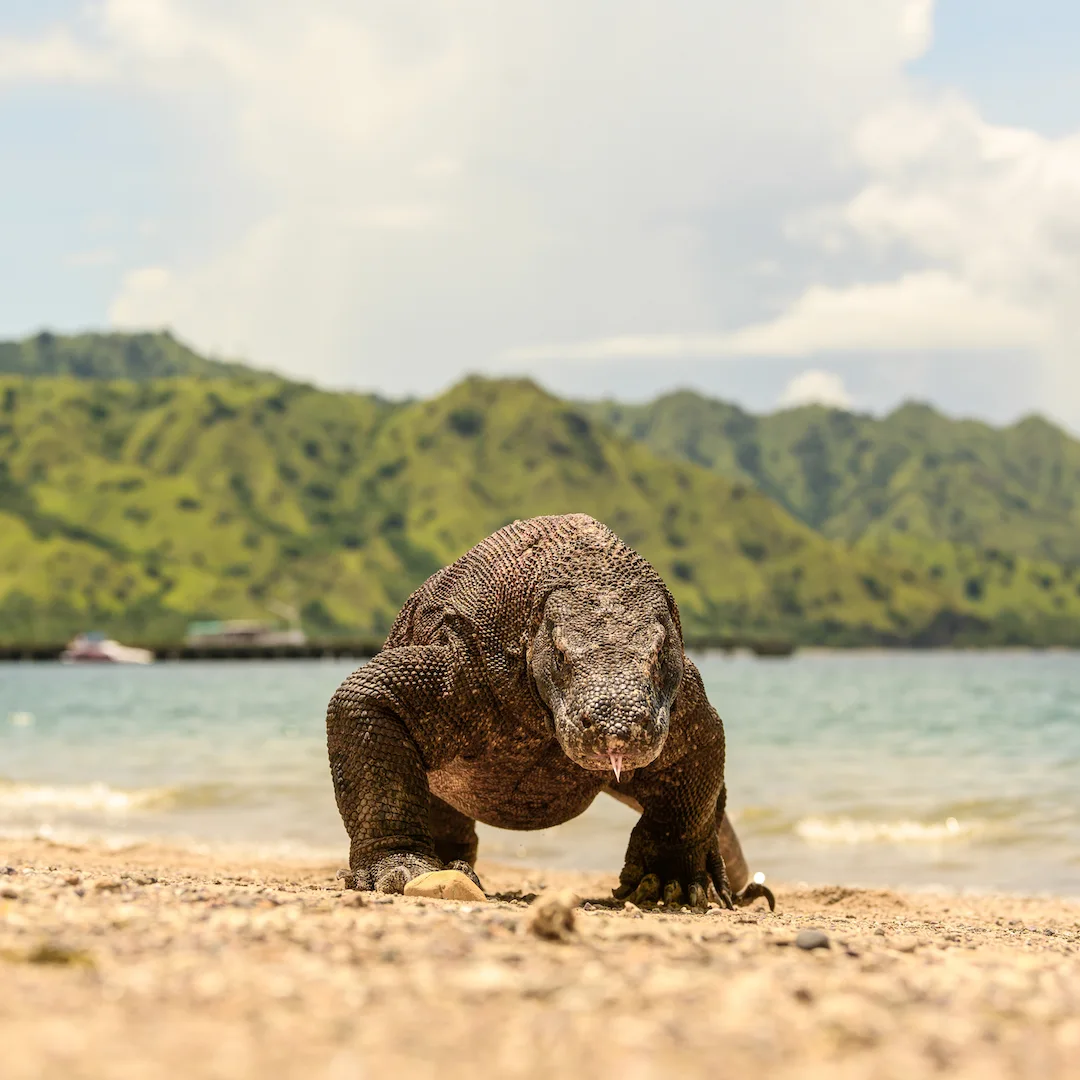
Short answer. The Catnazse itinerary goes to Komodo Island for the ranger-guided dragon trek at around 11:30 on day two. Rinca — the Loh Buaya area — is the alternative many other Labuan Bajo operators use. Both have resident dragons, both are ranger-led, and neither guarantees a sighting.
If you are comparing Komodo itineraries you will notice the two island names appearing almost interchangeably. They are not interchangeable. They are two different landings inside the same national park, with different terrain, different infrastructure and, on some tariff structures, different fees.
What is on the Catnazse route?
Komodo Island. Day one covers Kelor, Manjarite and Kalong; day two runs Padar at 06:00, Pink Beach at 09:00, then Komodo Island for the ranger-guided trek at 11:30, followed by Manta Point and Taka Makassar. Day three closes with snorkelling at Siaba and Sebayur before the return. The itinerary that includes Komodo Island sets it out hour by hour, and the four-day version adds Rangko Cave, Seraya, Sabolo and Bidadari on top of the same core.
Komodo Island and Rinca compared
| Komodo Island | Rinca (Loh Buaya) | |
|---|---|---|
| Position in the park | Larger western island, further from Labuan Bajo | Closer to Labuan Bajo, quicker to reach |
| Terrain | Broader, more varied; savannah and forest | Compact valley and low hills around the ranger station |
| Trail options | Short, medium and long ranger routes | Short and medium routes around Loh Buaya |
| Sighting pattern | Dragons move over a wider area | Animals often congregate near the ranger station |
| Typical visit length | Around 45–90 minutes on the trail | Often shorter, around 45–60 minutes |
| Also known for | Pink Beach nearby, larger landscape | Buffalo, macaques, wild boar alongside dragons |
| Fee structure | Some sources price Komodo + Padar as one band | Some sources price a Rinca-inclusive route higher |
Comparison of the two ranger-managed landing sites. Sighting patterns are tendencies reported by guides, not statistics.
How do ranger-guided treks actually work?
You land by tender at the ranger station, are counted in, and are assigned rangers — usually one at the front of the group and one at the back. They carry a long forked staff. That is not theatre: it is the standard tool for keeping distance between a group and an animal that has decided to be curious.
The briefing covers the same points every time. Stay with the group. Do not run. Do not crouch down at an animal’s level. Keep children in the middle of the group and within arm’s reach. Tell the ranger if anyone in your party has an open wound — dragons track scent extremely well and rangers take this seriously.
You then walk a loop. What you see depends on the day: dragons resting in shade near the station, a large male crossing a trail, nesting mounds, or on a quiet morning very little at all. Guides do not pretend otherwise, and the animals are not fed or baited to produce a sighting.
The rules that are not optional
- Never separate from the group or the ranger.
- Never run — movement away at speed reads as prey behaviour.
- Keep the distance the ranger sets, not the distance your camera wants.
- No food carried openly on the trail.
- Follow instructions immediately and without debate.
Dragons are genuinely dangerous animals and the safety culture around them is one of the more reassuring things about the park. An operator that takes that seriously usually takes the rest of its safety obligations seriously too — the questions worth asking before you book goes further into that.
What else you see on the trail
The dragons get the billing, but the walk itself is the reason a short trek is worth more than a photo stop. Both islands hold Timor deer, which are the dragons’ principal prey and the reason the animals stay where they do. Rinca in particular has water buffalo wallowing near the valley floor, macaques along the tracks and wild boar in the scrub. Komodo Island’s larger area carries more birdlife, including megapodes — the mound-building birds whose nests dragons raid, and whose abandoned mounds dragons then use for their own eggs.
Rangers point this out as you walk, and it changes how the place reads. You are not looking at a zoo enclosure with a large lizard in it; you are looking at a small, closed, dry-forest food web where the apex predator happens to be three metres long. Guests who go in expecting a guaranteed dragon photograph often come out talking about the deer.
Bring water and wear closed shoes. The trails are dry, dusty and hot by late morning, and the 11:30 slot on the Catnazse route is the warmest hour ashore on the whole itinerary.
Does your choice of island change the price?
It can. Reported structures include a per-visit band for a Komodo-plus-Padar route and a higher one for a route including Rinca. Because the tariff has been revised repeatedly, the sensible move is to have the fee confirmed against your named islands rather than against a generic “Komodo trip”. How fees change by route sets out the reported bands in full.
Komodo National Park entrance and activity fees are charged on top of every cruise price quoted on this site. Reported tariffs across 2025 and 2026 run from roughly IDR 150,000 to IDR 350,000 per person per day, with higher weekend and public-holiday tiers, and the structure has been revised more than once — ask the booking desk for a written breakdown covering your exact dates and route before you pay anything.
Which should you want on your itinerary?
If you are choosing between operators purely on this, do not. The dragon trek is one landing on a multi-day route, and both islands deliver it properly. What actually differentiates trips is everything around it: whether you reach Padar before the day boats, whether the manta stop is timed with the current, whether the boat you sleep on is comfortable. The operator’s safety and licensing page covers how the fleet handles the ashore component across vessels.
Frequently asked questions
Which island does Catnazse visit for the dragon trek?
Are you more likely to see dragons on Rinca or Komodo?
Can I walk without a ranger?
How long is the trek?
Is it safe for children?
Does visiting Rinca change what I pay?
Ask the crew directly
Ask us to confirm which islands are named on your departure’s route sheet. Catnazse Liveaboard is operated by Komodo Luxury, part of Juara Holding Group, working out of Labuan Bajo since 2015.
WhatsApp: +62 811 3823 875
Email: [email protected]
Instagram: @catnazse.liveaboard